
The Story
Why it exists.
The beginning
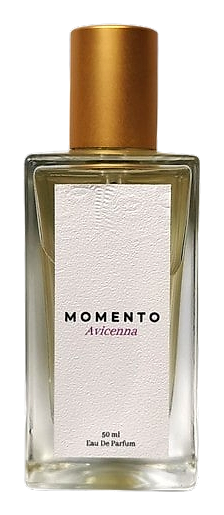
Avicenna takes its name from Ibn Sina, the 10th-century Persian polymath who, among a thousand other contributions, refined the process of steam distillation. His work with Rosa damascena, the Damask rose, produced both essential oil and rose water, commodities that would travel the trade routes linking Persia to India and China. Momento Perfumery built Avicenna around that legacy, launching in 2021 through a commission with perfumer Mladen Dragic. The brief was historical but not costume. A composition that honors the origin of distillation without leaning on orientalist shorthand.
The rose here is treated as an artifact, not a bloom. Vanilla absolute and Ceylon cinnamon do the heavy lifting in the heart, while benzoin provides the resinous spine that makes the whole thing read warm rather than confectionery. Pink pepper adds a flicker of heat early, a dry, almost crackling brightness that cuts through the denser notes and lifts the opening into sharper relief. The orris and violet underneath pull the composition toward something cool and slightly soapy, a counterweight to the gourmand warmth above.
The evolution
The opening belongs to bergamot and pink pepper, bright and slightly astringent, the way a citrus peel smells when you crush it between your fingers. The rose arrives early, too, but it doesn't announce itself as rose. It arrives as something warmer, older, pressed into the composition rather than placed on top. As the hours pass, benzoin and vanilla take over the architecture, and the cinnamon that was whisper-quiet in the opening now reads as a low, steady hum underneath the resin. The drydown is where this fragrance earns its name. Benzoin, vanilla, and a soft musk settle into a warmth that reads like the room after the candles go out. The composition shifts gradually, each phase handing off to the next without abrupt breaks, and the final hours feel like a slow, contented fade rather than a disappearance.
Cultural impact
Momento Perfumery built Avicenna around the legacy of Ibn Sina, the Persian polymath whose work on steam distillation helped define how we capture botanical essence today. The fragrance reads as an act of reverence, an attempt to translate the labor and ingenuity of early distillation into something wearable. Wearers tend to be collectors who want the story, not just the projection. The composition holds a quieter register than the louder, sweeter ambers that dominate mainstream shelves, favoring depth and material specificity over immediate sweetness, and in doing so it invites a slower kind of attention.