
The Story
Why it exists.
The beginning
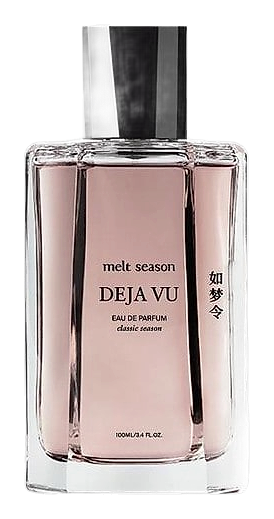
Deja Vu draws its breath from the poetry of Li Qingzhao, the writer behind Rumengling, one of the classical texts that still circulates through Chinese literary memory. The title borrows its name directly from her work, placing the 2024 composition in conversation with a source text rather than simply borrowing its mood. Melt Season built the fragrance with perfumer Miroslav Petkov, and the collaboration produces something worth lingering over. The fragrance asks to be read as a sequence, with each note arriving in soft conversation with the last, the way a remembered line of poetry surfaces unbidden during a quiet afternoon.
What makes the composition unusual is how few loud materials it leans on. Hop gives the opening a green, almost vegetal bitterness that reads as memory itself, the kind of scent that pulls you backward before you've named what's happening. Ambrette seeds bring a skin-like musk without the animalic edges, a warmth that registers as closeness rather than noise. Rice bran anchors the base with a toasted, almost nutty grain, contributing the kind of quiet sustenance that holds a composition upright. Each choice pulls toward understatement. Nothing announces itself.
The evolution
The first minutes belong to the pear, and it's a fact that wins people over quickly. That crisp sweetness sits on top of the hop's green bitterness, and the two negotiate while the pink pepper flickers through, present without ever committing to spice. The rose arrives as the composition settles, and it reads quietly rather than loudly: a dried-petal quality, leaning toward the softness of paper rather than the dewy weight of a fresh bouquet. Ambrette brings a fleshy musk that warms the heart from underneath, and opoponax contributes a resinous pull that gives the middle phase its gravity. The heart runs warm and unhurried, letting each material speak in turn without any one of them rising above the rest. Then the base asserts itself.
Cultural impact
Deja Vu carries a literary reference at its core. The title, drawn from the Chinese lyric verse form known as Rumengling, directly references Li Qingzhao's poetry, anchoring the fragrance in a classical Chinese text that has circulated for centuries. The title itself appears within the Chinese literary tradition as a recognized form of lyric verse, and naming a fragrance after it sets up a deliberate conversation between contemporary scent-making and the older rhythms of Chinese poetic form. There's a kind of quiet confidence in choosing a classical reference and letting the composition do the rest of the talking, without leaning on the literary connection as a marketing gesture.