
The Story
Why it exists.
The beginning
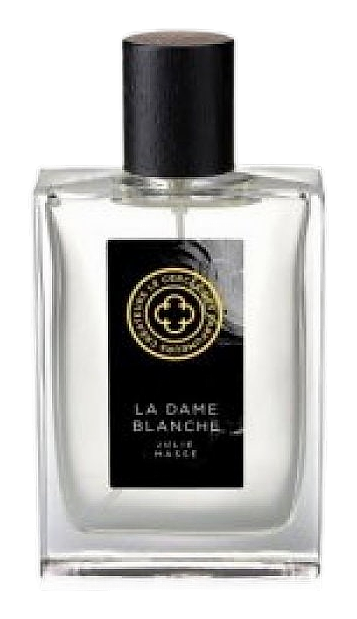
La Dame Blanche takes its name from the White Lady, a figure that haunts European folklore as both ghost and goddess, the death-crone in a white dress who appears luminous and terrible. The French phrase, more lyrical than the English, carries something softer: not just a ghost, but a feminine ideal rendered in white, a kind of spectral presence. Julie Massé composed this for Le Cercle des Parfumeurs Createurs, whose operating principle is simple and declarative: the perfumer's name goes on the bottle. Massé's name is on this one. The reference is less to horror than to a specific kind of feminine haunting, the woman in white who doesn't scream or threaten, she simply appears, luminous and unsettling, and you can't quite explain why you can't stop looking.
The composition does something rare with a limited material list. Blackcurrant bud and lemon give the opening a sharp, almost bitter greenness that reads more like snapped stems than fruit, an aromatic bitterness that cuts cleanly through the air. May rose and tuberose in the heart deliver a creamy, indolic softness without tipping into the heady, tropical excess that tuberose often brings, the rose pulling it back toward something classical and powdery.
The evolution
The opening moments are sharp and bright, the blackcurrant bud cutting in with an almost herbal greenness, like the smell of a leaf torn in half, with lemon lifting the top into something colder and more electric. That green phase doesn't linger long. Then the florals arrive, not gradually but in a single shift, the May rose showing up first with its dewy, jammy sweetness, and the tuberose following with that thick, milky, almost carnal quality. The middle phase is where the composition lives longest, the rose and tuberose intertwining, the white-floral creaminess sitting close to the skin and never becoming theatrical. There's a softness to this phase that feels deliberate, a refusal to project or to fill a room, as though the fragrance were designed for the wearer's collarbone rather than the airspace of a crowded room.
Cultural impact
Within Le Cercle des Parfumeurs Createurs, where every release carries a named perfumer's name and credit on the bottle, La Dame Blanche sits as a quiet, composed white-floral composition that rewards slow smelling. The collective's philosophy of putting the perfumer's name on the bottle rather than letting a brand obscure the maker is part of what gives the release its character, a transparency about authorship that mirrors the fragrance's own refusal to hide its materials.