The Story
Why it exists.
The beginning
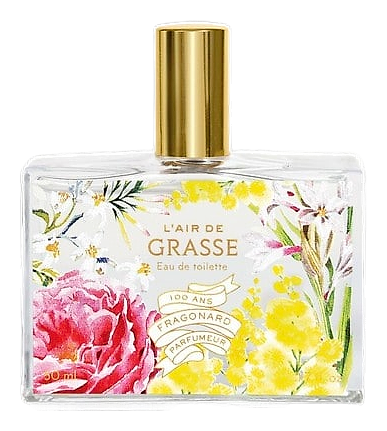
Fragonard has been making perfume in Grasse since 1926. A century of harvests, distillations, and compositions rooted in the same soil. L'Air de Grasse was built to mark that milestone, a fragrance that doesn't just reference the city, but translates it. Karine Dubreuil-Sereni didn't reach for a grand gesture or a statement scent. She reached for the air itself. The actual atmosphere of a place where fields of jasmine and rose stretch to the foothills, where the morning breeze carries floral wax and citrus peel, where the region's perfume is so saturated it becomes architecture. The name says it plainly: L'Air de Grasse. The air of Grasse. Wear it and you're wearing the town's signature.
The structure earns attention precisely because it shouldn't work. Six heart notes, Peony, May Rose, Jasmine, Mimosa, Orange Blossom, Tuberose, is more white floral than most compositions attempt. The risk is density, noise, a garden that shouts. What happens instead is something quieter: each bloom finding its space, layering without mudding, the way flowers actually crowd a bed in high summer. The tension between jasmine's cream and tuberose's green bite creates movement. The mimosa's honeyed softness anchors the orange blossom. Peony adds the blush that makes it wearable rather than abstract.
The evolution
The mandarin opens quick and citrus-bright, a few minutes of sparkle before the garden arrives. No one note dominates the heart, instead, six florals emerge in a compressed wave, each one distinguishable for a moment before they blend into a warm, powdery bloom that reads as singular. Jasmine and tuberose hold the center. Peony adds softness. May rose threads through without announcing itself. By hour three, the white florals have quieted and the iris begins to assert itself, powdery, violet-soft, slightly earthy. Patchouli keeps it grounded. This is where L'Air de Grasse earns its longevity: the drydown is intimate, close to the skin, the kind of scent another person discovers only when they're near. On fabric, the iris and patchouli can last into the next day, faint and pleasant. On skin, expect four to six hours of presence before it becomes a skin scent, then a memory.
Cultural impact
Fragonard's centenary fragrance arrived in 2026 as a quiet counterpoint to the brand's own heritage, not a retrospective of greatest hits, but a new composition built from the region's living materials. L'Air de Grasse occupies the space between artisanal craft and accessible luxury, appealing to wearers who want Grasse expertise without the performative weight of niche positioning. The refined white floral structure aligns with the house's broader catalog of restrained compositions, while the centenary context gives it extra resonance for collectors.