The Story
Why it exists.
The beginning
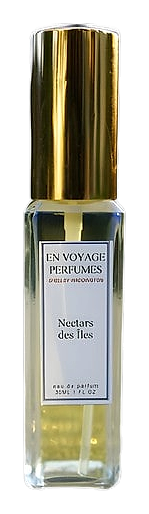
Nectars des Iles was born from the idea of capturing a Caribbean island bouquet, the kind that grows without permission, spilling over fences and perfuming the humid air. The perfumer Juan M. Perez worked with a specific brief: translate the abundance of tropical flowers into something wearable, not chaotic. Osmanthus nectar for sweetness without sugar. Creamy gardenia and frangipani at the center, anchored by Pacific sandalwood and Tahitian vanilla. Released in 2011 as part of En Voyage's early catalog, it remains one of the house's most transportive compositions, a bottle that actually earns its travel narrative.
What sets this apart from a standard tropical floral is the osmanthus. It's not a common top note, the apricot-tea nuance adds a slightly bitter sweetness that keeps the opening from feeling like sunscreen. Combined with the multi-floral heart (frangipani, gardenia, tiare, jasmine auriculatum, ylang-ylang all absolute-strength), there's a density here that's almost architectural. The creamy coconut impression some wearers report isn't listed as a note, it's what happens when frangipani absolute meets Tahitian vanilla. A happy accident the perfumer clearly leaned into.
The evolution
The opening arrives fast, citrus and osmanthus nectar together, bright and tart, the way sunlight hits wet stone. Within 20 minutes, the tartness softens as gardenia and tiare push through, replacing sharp with creamy. The heart is where this fragrance earns its name: frangipani, jasmine, and ylang-ylang bloom into something lush, almost sticky with tropical richness. There's a coconut impression here that sneaks up, the frangipani-vanilla blend doing something unexpected. The drydown settles quiet: sandalwood, amber, white musk. Not a statement. An exhale. Intimate, close, the kind of sillage that's really only apparent to the wearer.
Cultural impact
Nectars des Iles occupies a specific niche: the tropical floral that doesn't default to sunscreen or sunscreen-marketing. It's been noted by fragrance writers as one of the more convincing island-atmosphere compositions from an American indie house, particularly for its use of osmanthus and the frangipani-vanilla interplay that creates an accidental coconut impression. The 2011 launch places it early in the niche-floral boom, before the category became crowded.