The Story
Why it exists.
The beginning
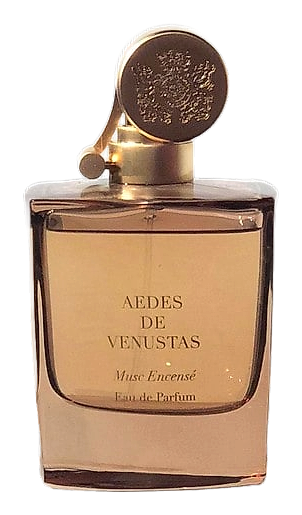
Musk and incense pull in opposite directions. One is intimate, human, skin-warm. The other belongs to temples and ceremony, something ancient and otherworldly. When Ralf Schwieger set out to compose Musc Encense for Aedes de Venustas in 2018, the tension between these two materials wasn't a problem to solve. It was the brief. The question wasn't whether to combine them, but how far into either direction to lean. Schwieger's answer was restraint, treating incense not as something to burn loudly, but as something to smell quietly, almost meditatively, the way someone breathes in a room they've entered alone.
Most incense fragrances announce themselves. Swings of smoke, pillars of myrrh, the whole church arriving at once. Musc Encense does the opposite. The incense sits low in the composition, more whisper than pyre, softened by musk until it reads as warmth rather than spectacle. What makes this interesting is the structural choice: Schwieger built the body of the fragrance around materials that don't typically lead, clary sage as top, cashmeran in the base, letting the musk and frankincense act as seasoning rather than main course. The result is a composition that feels studied rather than performed.
The evolution
The opening is clary sage first, sharp and green against a soft musk backdrop. It arrives dusty, almost dry, the smell of something old, not new. Within the first hour, the incense emerges quietly, not smoky so much as resinous, settling into the skin rather than rising from it. The heart brings jasmine and woody notes forward, and for a moment the fragrance reads cleaner, more floral than expected. Then the drydown arrives. Tonka bean adds a faint sweetness, cashmeran makes everything feel close and skin-like, and the incense refuses to leave. Eight to ten hours later, this fragrance is still there, not projecting, not demanding. Just warm. The kind of presence you notice when someone walks past you and the air behind them smells like a room you want to enter.
Cultural impact
Musc Encense arrived in 2018 during a period when incense-forward compositions were having a mainstream moment, but most of those fragrances leaned loud, smoky, performative. Schwieger's restraint positioned the composition differently: closer to skin, less declarative, rewarding the wearer who didn't need to announce themselves. For collectors in the Aedes de Venustas orbit, those who approach fragrance as study rather than costume, this kind of quiet intensity reads as confidence rather than absence.