
The Story
Why it exists.
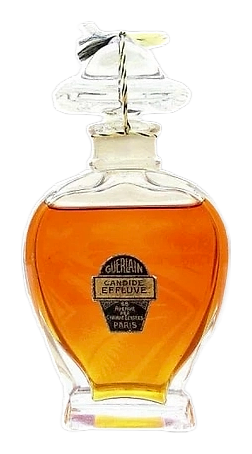
Candide Effluve debuted in 1922, crafted by Jacques Guerlain at a time when Paris was redefining elegance after the war. The house, founded in 1828, had already earned a reputation for marrying scientific precision with artistic flair. With this extrait, Guerlain sought a perfume that captured innocent freshness while hinting at the sophisticated powdery allure that would become a signature of the brand.
If this were a song
Community picks
La Vie En Rose
Édith Piaf
The Beginning
Candide Effluve debuted in 1922, crafted by Jacques Guerlain at a time when Paris was redefining elegance after the war. The house, founded in 1828, had already earned a reputation for marrying scientific precision with artistic flair. With this extrait, Guerlain sought a perfume that captured innocent freshness while hinting at the sophisticated powdery allure that would become a signature of the brand.
What makes the composition stand out is the dual presence of heliotrope, appearing both at the opening and anchoring the base, creating a continuous powdery thread. Violet and lilac give a crisp floral spark, while bergamot adds a citrus lift. The heart’s blend of jasmine, ylang‑ylang and benzoin introduces warmth, and the amber‑rich base grounds the scent in timeless elegance.
The Evolution
At first spray, violet and lilac bloom beside a crisp bergamot, the heliotrope whispering from the start. Within minutes the bouquet deepens as jasmine and ylang‑ylang mingle with benzoin, while patchouli and rose add an earthy‑sweet undercurrent. As the perfume settles, the base heliotrope and iris emerge, softened by amber that glows like fading candlelight. The dry‑down lingers for eight hours, leaving a powdery, slightly sweet trail that feels like a well‑kept secret revealed at dusk.
Cultural Impact
Although discontinued for decades, Candide Effluve was resurrected in a limited 2007 re‑issue, sparking renewed interest among vintage collectors. Since 2014 the original 1922 extrait has been displayed in Guerlain’s Hall of Mirrors, cementing its status as a historic icon. Wearers often describe it as the scent of a refined Parisian salon, a timeless choice that bridges early‑20th‑century elegance with today’s desire for classic powdery florals.
The House
France · Est. 1828
Guerlain stands as one of the oldest and most revered perfume houses in the world, founded in Paris in 1828 by Pierre-François-Pascal Guerlain. What began as a boutique on rue de Rivoli quickly became the preferred destination for Parisian society, attracting dandies and elegant women who sought custom-crafted fragrances. The house's influence grew to such heights that Guerlain earned the title of Official Perfumer to Napoleon III after presenting Eau de Cologne Impériale to Empress Eugénie as a wedding gift in 1853. This royal patronage marked the beginning of Guerlain's enduring association with European aristocracy, as the house went on to create fragrances for Queen Victoria and Queen Isabella II of Spain. Today, under the creative direction of Thierry Wasser, the fifth-generation perfumer, Guerlain continues to shape the landscape of fine fragrance with a portfolio spanning over 1,100 olfactory creations. The house remains headquartered at its legendary Champs-Élysées mansion, a historic monument that anchors Guerlain's position at the intersection of heritage and contemporary luxury.
If this were a song
Community picks
A delicate waltz of vintage elegance, echoing the perfume's powdery floral heart with a soft, lingering melody that feels like a Parisian salon at dusk.
La Vie En Rose
Édith Piaf