
The Story
Why it exists.
The beginning
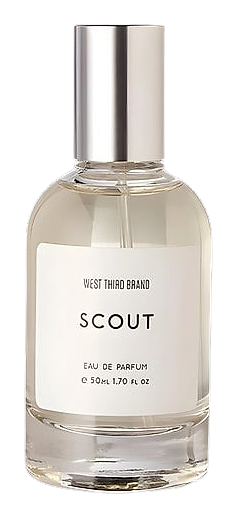
Scout arrived in 2014 as part of West Third Brand's debut catalog, composed by perfumer Michael Loring Probst. The composition draws on a classic fougère template reimagined through an oriental lens, where lavender and orange blossom meet balsam and labdanum in a portrait of controlled contrast. Scout reads as a quiet kind of confidence, the kind of wearer who doesn't need to announce herself because the scent settles into the room before she does. There is nothing tentative about the accord. The lavender opens clean and green, the orange blossom arrives bright and almost solar, and underneath both runs a current of balsam and labdanum that gives the whole composition its gravity.
What makes Scout worth slowing down for is how confidently it balances two registers that don't always agree with each other. The lavender keeps everything tempered and clean, a cool, almost barbershop-crisp thread running through the center that keeps the florals from drifting into syrup. The orange blossom, for its part, offers a brighter, sunnier lift, the kind of white-flower glow that feels less like a bouquet and more like light through a window. Then the base materials earn their keep.
The evolution
Scout opens on a wash of green lavender lifted by the radiant brightness of orange blossom. In the first minutes, the lavender reads as cool and slightly herbal, almost cool to the touch, while the orange blossom hovers just above it, white and luminous. There is an immediate freshness here that reads more like a well-cut cologne than a modern floral, a crispness that feels intentional rather than accidental. As the early stage settles, the orange blossom begins to soften, losing some of its solar edge and rounding into something creamier, almost pollen-like, while the lavender takes on a faintly spiced dimension. The balsam arrives quietly during this transition, a low cool resin note that threads underneath the florals and gives them somewhere to land.
Cultural impact
Scout occupies an interesting place in the contemporary niche fragrance conversation because it doesn't perform its niche credentials loudly. The composition leans on materials that perfumery has known for over a century, lavender, orange blossom, balsam, labdanum, arranged into a structure that feels both familiar and quietly revised. That kind of restraint reads as confident in a market where many launches chase novelty through unusual accords or aggressive projection. West Third Brand's approach with Scout treats the fragrance as a complete object rather than a statement, something designed to be worn and revisited rather than decoded.