The Story
Why it exists.
The beginning
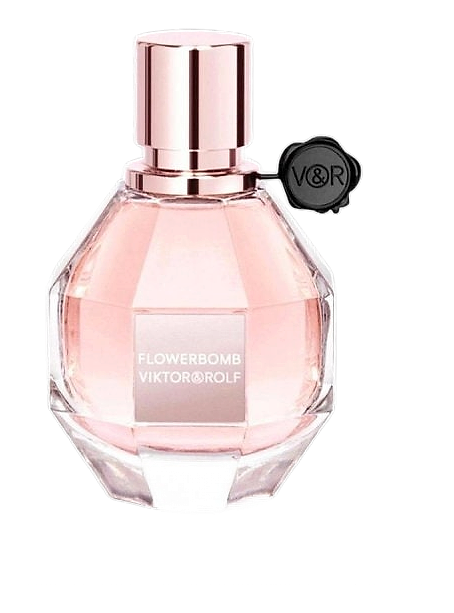
Flowerbomb arrived in 2005, timed to the 10th anniversary of Viktor & Rolf's house. The name says everything, flowers detonating, blooming all at once, refusing to arrive quietly. Four perfumers built it together: Olivier Polge, Carlos Benaïm, Domitille Michalon-Bertier, and Dominique Ropion. Their brief was simple on paper, harder in execution: capture the moment flowers finally bloom, that beauty that can't be taken back. The diamond-shaped bottle was designed by Fabien Baron as a physical echo of the scent inside, something precious and geometric holding something wild.
What makes Flowerbomb unusual is the way it holds sweetness and structure in the same hand. Jasmine and orchid could easily tip into cloying; the bergamot and tea in the opening keep everything bright and slightly green, pulling the florals back from the edge. Then patchouli enters, not animalic, not heavy, just grounding enough to give the sweetness somewhere to live. The rose isn't prominent on paper, but it shows up in the drydown, softening the patchouli into something that smells like powder and warmth rather than earth. It's a composition that knows what it wants to be and never wavers.
The evolution
The opening hits bright and clean, bergamot and tea arrive together, sharp and green. Within minutes, jasmine takes over. Not delicate jasmine, not polite jasmine. Jasmine that means business. Orchid and freesia follow, swelling into a heart that smells opulent, almost creamy. This is the phase people notice first, the one that gets compliments. Then, around the two-hour mark, the florals begin to soften. Patchouli settles underneath, not pushing the florals away but holding them up. The rose arrives quietly in the base, adding a powdery warmth that stays close to skin for hours. On some skin, it becomes almost skin-like by hour eight. On others, it still announces itself. Either way, it doesn't quit early.
Cultural impact
Flowerbomb won the Fragrance Hall of Fame prize in 2023, cementing its status as a modern classic. It defined a generation of sweet florals and remains one of the most recognizable fragrances in the world. The bottle, designed by Fabien Baron in a diamond-granate shape, has become iconic in its own right.