The Story
Why it exists.
The beginning
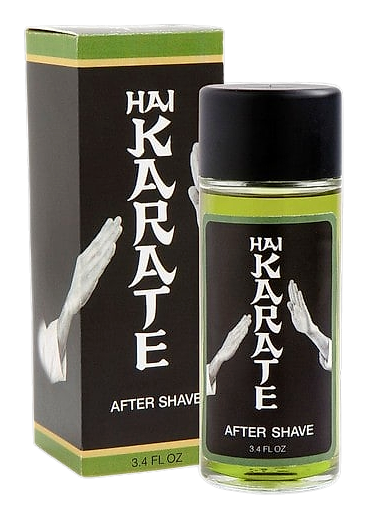
Hai Karate arrived in 1967 with a martial arts branding flourish and a warning in its name. The Leeming division of Pfizer, better known for pharmaceuticals than perfume, launched this men's aftershave during a wave of American fascination with Japanese martial arts. The packaging leaned hard into that cultural moment. The fragrance itself opened with sharp citrus notes, bright bergamot and lemon that cut through the air with an almost medicinal precision, softened only slightly by the presence of green basil. Beneath those top notes lay deeper complexities that hinted at the company's unfamiliarity with artistic perfumery. Pfizer was never a fragrance house. The company's expertise lay in rigorous scientific methodology and chemical manufacturing, not artistic olfactory composition.
What emerged from that experiment was a straightforward citrus-aromatic cologne built on a green herbal heart. Basil and lemon opened sharp and clean, supported by bergamot's bright citrus and lavender's softening effect. The heart paired geranium's floral complexity with patchouli's earthiness and a whisper of rose. Musk and powdery notes anchored the base. The composition didn't aim for artistry, it aimed for clean, reliable wearability. The kind of scent that belonged on a pharmacy shelf next to talcum powder and razor blades, doing its job without pretense.
The evolution
The opening hits sharp and medicinal. Bergamot and lemon cut bright against green basil, the kind of potency that announces itself without apology. The research describes it as sour and sharp, citrusy in a clinical way. That initial burst brings to mind antiseptic sharpness, the kind of cleanliness associated with medical environments rather than elegant perfumery. The herbs emerge as the citrus begins to settle, with basil asserting itself in a way that feels deliberate and measured rather than naturally evolving. The heart arrives with geranium and patchouli taking center stage, rose lending subtle sweetness beneath. This is the fern-like, barbershop middle section, clean and herbal. The green notes don't disappear but they soften, the composition settling into something more familiar. The drydown belongs to the powdery musk.
Cultural impact
Hai Karate exists as a time capsule of its era, a straightforward masculine cologne that relied on clean wearability rather than artistic ambition. The discontinued formula represents a moment when companies outside traditional fragrance houses chose to experiment with scent creation. For those who remember it from pharmacy shelves in the late '60s and '70s, it remains a marker of its period.