
The Story
Why it exists.
The beginning
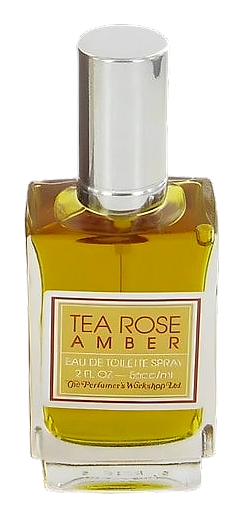
The original Tea Rose arrived in the mid-1970s and became one of those rare fragrances that simply endures, a true, balanced rose with no tricks, no agenda, just honest florals doing exactly what they were made to do. For twenty-four years it stood alone as the house's signature. Then came 1999, and a flanker: Tea Rose Amber, built to extend the legacy without rewriting it. The idea was straightforward, take the rose that worked, lean into the amber warmth already threaded through the original, and make it more approachable. Spicy notes were added not to complicate things but to ground the powder, giving the flanker a slightly different character without losing what made the first one work. This is what flankers are supposed to do: honor the source, then stand on their own feet.
What separates Tea Rose Amber from the original is the amber backbone shifting the composition's center of gravity. In the original, the rose leads from the first spray and stays there through the drydown. In the Amber version, the rose shares the stage with a warm, slightly resinous base that softens the florals and adds staying power. The powdery notes, present in both, feel more pronounced here, which gives Tea Rose Amber its vintage character. The spicy notes are not a signature move; they are a quiet seasoning, there to keep the powder and amber from becoming too sweet.
The evolution
The opening is the amber announcing itself first, then the rose following close behind, not competing, just arriving in sequence. What arrives in the first twenty minutes is powdery warmth with a faint floral hum underneath, nothing sharp, nothing demanding. Around the forty-minute mark the Tea Rose asserts itself, but differently than in the original: softer here, pressed down by the amber rather than standing free. The spicy notes appear as the rose settles, a subtle warmth that prevents the composition from becoming too sweet or too static. By the second hour the rose has quieted considerably and the amber-powder base takes over completely, warm, close, the kind of drydown that only the wearer notices until someone leans in. On fabric it lasts into the next day. That is the quiet payoff: not a fragrance that announces itself all evening, but one that rewards the close encounter.
Cultural impact
Tea Rose Amber belongs to a lineage of flankers that had to earn their place next to something beloved. The original Tea Rose built its reputation across the 1970s and 80s as a counter-service curiosity, rose done without fanfare, without niche positioning, just well-balanced florals at a department store price. The Amber version inherited that ethos while carving out its own territory in the powder-amber space. What wearers consistently describe is the ease of it: no sharp edges, no aggressive sillage, no demand for an occasion. It wears like an old preference rather than a new discovery.