
The Story
Why it exists.
The beginning
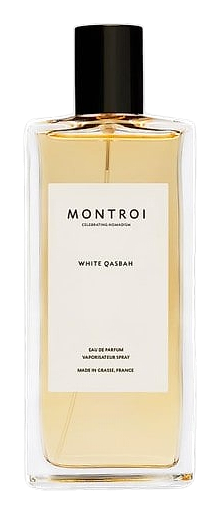
White Qasbah sits inside Montroi's catalog of place-driven fragrances, a composition that reads first as landscape and second as scent. The name itself draws a line toward the whitewashed citadels of the Arabian Peninsula, the old fortified quarters that still anchor the region's trading towns. It is, in Montroi's framing, an olfactory postcard from a specific place: this one happens to look toward the heritage of the Silk Route and the Arabian trade roads that shaped how the world learned to smell. At the top, saffron and raspberry do the opening work together, a pairing that recalls the heat and sweetness of a bazaar in motion, spice stacked on dried fruit, neither one shouting over the other.
The structure leans into a chypre floral architecture, but with a Middle Eastern accent that gives it weight. Saffron and raspberry open the door together, one bright and slightly bitter, the other pulpy and generous. Rose and oud hold the middle, a pairing that has anchored Arabian perfumery for centuries, though here it shares space with sandalwood's creamier register. The base grounds everything in materials with serious track records. Leather contributes a dry, animalic warmth that reads as supple rather than sharp, the kind of leather note that feels more like worn hide than new tack.
The evolution
Saffron takes the opening alone. It hits with a clean, almost metallic heat, the kind that makes your tongue dry, and the raspberry arrives underneath as a tart, jammy counterweight before you register it fully as fruit rather than as a smear of color. The first movement is short and sharp, all spark and surface, and then the temperature drops. Rose steps forward, deep and slightly honeyed, with oud threading through it. The oud here behaves less like a medicinal note and more like something that has been breathing in a closed room, woodier, rounder, closer to smoke that has settled into drapery. As the composition moves into its lower register, leather arrives first, dry and supple, then patchouli with its dusty herbal edge, then nagarmotha doing what nagarmotha does: turning everything a shade smokier and a shade older.
Cultural impact
White Qasbah draws from the Arabian perfume tradition without inheriting all of its conventions. It is an oud-rose composition shaped for someone who already knows that territory and wants to walk through it again with a slightly different map, one where the saffron is brighter, the raspberry is sharper, and the leather and nagarmotha base carry more weight than the sweeter mainstream alternatives. The base does real work here, giving the fragrance a dry, grounded character that works well in cooler weather, when the heavier materials have room to open up and the smoke-root edges of nagarmotha can register cleanly against skin.