
The Story
Why it exists.
The beginning
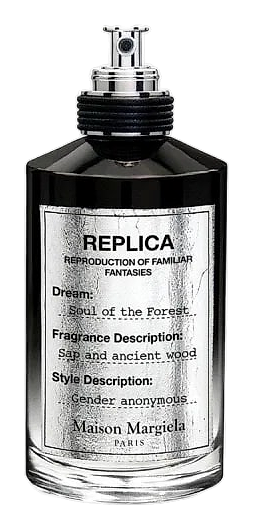
In 2016, when perfumer Quentin Bisch received the Replica brief, the assignment wasn't 'make a forest scent.' It was 'make the feeling of a forest.' That distinction matters. Maison Margiela doesn't sell notes, it sells memories, places, moments rendered in olfactory form. Soul of the Forest was the house's answer to a question: what does ancient woodland smell like, if you've never tried to recreate it literally?
The answer lies in the pyramid's unusual architecture. Blackcurrant bud and allspice open the composition, not the citrus or herbal bridges most woody fragrances rely on. These materials build a green, almost tart atmosphere before the forest proper arrives. The heart pairs balsam fir with cistus concrete, a labdanum absolute that adds resinous warmth without sweetness. Plant sap, a material rarely named in perfumery, anchors the mid-phase with something mineral and slightly medicinal. The effect is less 'walking through trees' and more 'the space between them.'
The evolution
The opening doesn't perform. Blackcurrant bud arrives quietly, tart, slightly sour, like crushed berries at the forest's edge. Moss follows as a cool, damp presence, mineral and green. The fir doesn't storm in. It builds, slow and resinous, until the entire composition reads as coniferous. As the heart settles, the labdanum emerges, warm, resinous, almost amber-like without the sweetness. This is where the fragrance earns its name. The drydown belongs to cedarwood, Indonesian patchouli, and frankincense. The frankincense doesn't smoke, it lingers, close to skin, contemplative. Cedar and patchouli ground everything into earth. Most users report a full workday without reapplication. The sillage stays intimate throughout, present to those beside you, invisible to those across the room.
Cultural impact
Soul of the Forest occupies a specific niche: the nature-lover who doesn't want literal forest. It's for the person who finds 'outdoorsy' fragrances either too synthetic or too safe. The Replica approach, conceptual rather than representational, separates it from peers like The Vagabond Prince's Enchanted Forest. Community response values its authentic pine character, its meditative green opening, and its ability to smell natural rather than constructed. The tradeoffs are real: moderate projection, inconsistent longevity on dry skin, and a discontinued status that makes the bottle harder to find. Those who own it tend to reach for it regularly.