The Story
Why it exists.
The beginning
In 1928, Mascarade entered the catalogue of L.T. Piver, a French house that had been shaping colognes and bouquets since the late eighteenth century. The name evokes the theatrical pleasure of a masked gathering, a ritual of concealed faces and quiet revelation where gloves are removed and identities shift half into view. Piver's catalogue already held a long tradition of discreet colognes by this point, and Mascarade arrived in that lineage: feminine in intent, powdery in register, built for skin rather than spectacle. It stayed loyal to the house's old-fashioned restraint, holding its composure even as the perfumery around it grew louder and more decorative.
What makes Mascarade worth attention is its dedication to a now-rare register: a cologne-strength powdery floral that refuses to inflate into a modern extrait. Mascarade holds its line at a featherlight concentration, moving through its life close to the body without ever pushing outward. The composition feels less like a product and more like an atmosphere, one that the house has let stand on its own for nearly a century. The restraint is the point, and that restraint carries through every phase of the wear.
The evolution
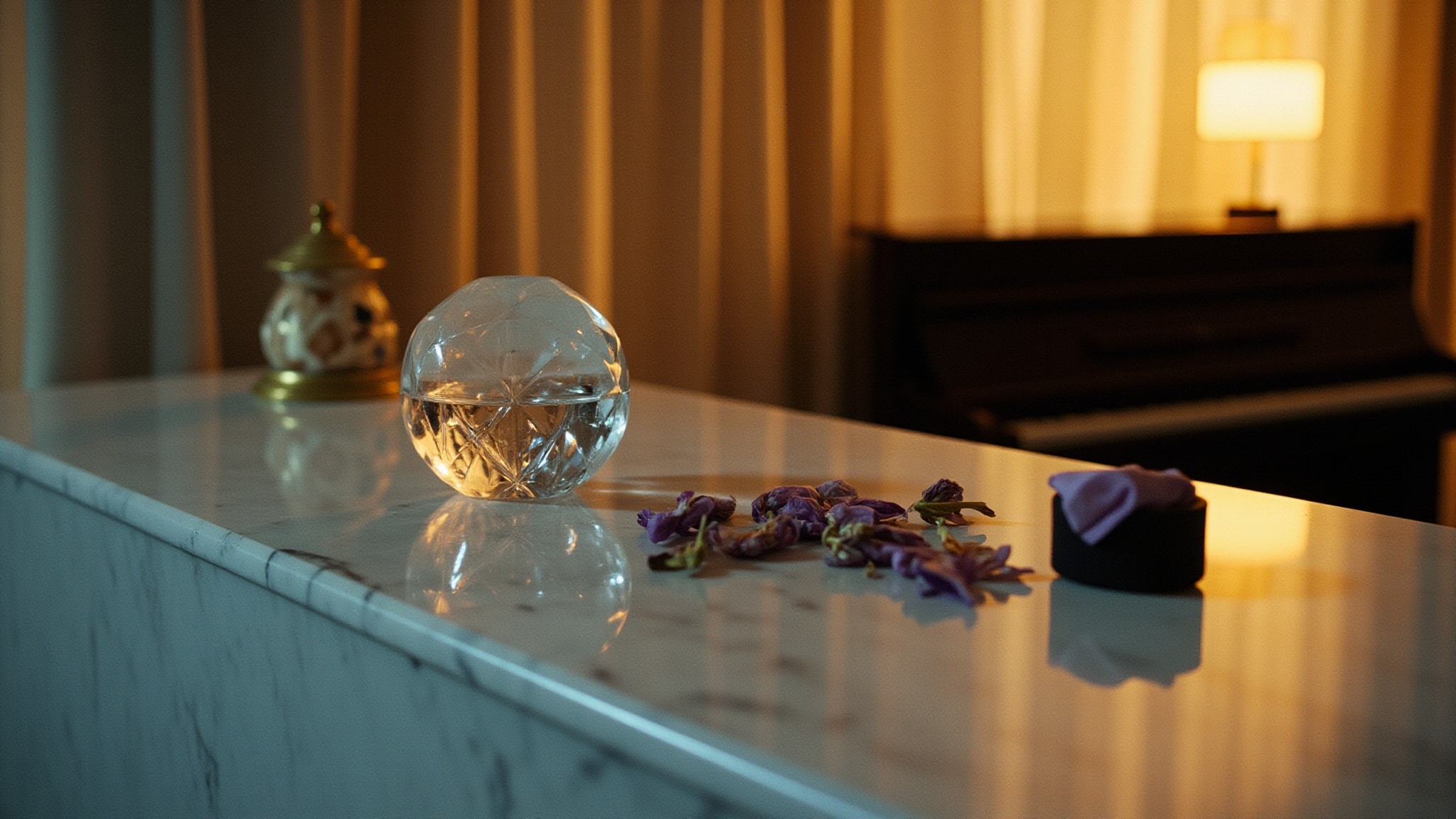
The first half hour is the cologne speaking loudest: a bright, almost mineral flicker over the powder, like cold light through sheer curtains. Then the powder deepens, settling into a warmth that sits very close to the skin. By hour three, what remains is a dry, faintly sweet warmth, slightly papery, almost like the inside of a lacquered jewelry box. It does not project past arm's length and it does not try to. On fabric, traces of it survive into the next morning, faint and papery, the ghost of a gesture. Worn in cool weather, the powder reads fuller; in summer heat, it thins to an almost translucent veil. The sillage softens with each hour, the trail contracting until the scent becomes something only the wearer reliably registers, a private signature more than a public statement.
Cultural impact
Mascarade occupies a particular place in the Piver archive, a composition that returns in vintage catalogues and conversational lists among those who follow the house's older work. For wearers, it functions as a reference point rather than a trend piece, the sort of scent that signals familiarity with the deeper layers of Piver's history. It rewards patience, rewards attention, and asks for a kind of wear that is unhurried and intimate. In a fragrance landscape tilted toward louder compositions, Mascarade persists as a quiet alternative, a reminder that some of the most compelling French perfumery still speaks in a hushed register.