The Story
Why it exists.
The beginning
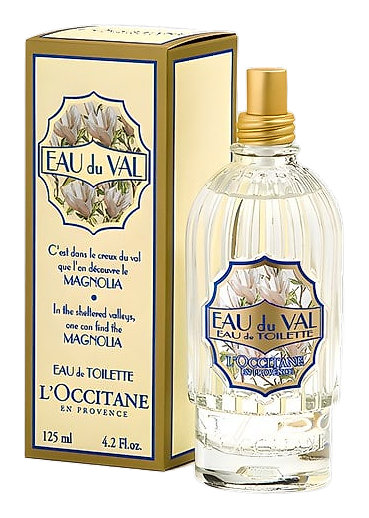
Eau du Val launched in 2004 as part of L'Occitane's growing fragrance portfolio. The name itself, "water of the valley," suggests a sheltered space where blossoms open quietly out of direct sunlight. The Magnolia edition treats the magnolia flower as its subject: a creamy, lemony coolness, the kind of soft-petaled bloom you'd find tucked into a corner of a walled garden where the morning stays cool and damp. There's no herbal field here, no wild rosemary or lavender stacked into the composition. Just the magnolia, placed at the center, with its pale citrus undertone and smooth, waxy petal texture doing all the talking. The flower carries a particular weight in perfumery, often used as a bridge between lighter florals and warmer musks, and this composition leans into that role fully.
What makes this composition interesting is its restraint. Magnolia, freesia, tuberose and musk. Four materials, no shouting. Freesia sharpens the magnolia's creaminess with a green pepper edge, while tuberose adds the indolic depth that stops the blend from reading as soapy. Musk anchors everything. The blend reads as a quiet white floral study rather than a loud composition built for impact. The interplay between the freesia and the tuberose is particularly worth noticing: one brings the cool, green snap of crushed stems, the other brings a creamy, almost narcotic warmth.
The evolution
The first fifteen minutes belong to freesia. That green coolness hits first, lifting the magnolia from behind like a breeze through branches. The opening makes you think of early spring rather than high summer, with a crisp, almost dewy freshness settling over the magnolia's creaminess. Around the twenty-minute mark, the tuberose arrives, not loudly, but enough to warm the cool petals into something more lived-in. The indolic edge adds a faint creaminess, like sun on white linen. By the one-hour point, the musk has settled in fully. The magnolia hasn't disappeared. It's been absorbed, translated. What started as a garden flower becomes a skin scent, warm and close and just faintly sweet. As the hours pass, the composition continues to soften. The freesia recedes almost entirely after the first half hour, leaving behind a hazy green memory that lingers at the edges.
Cultural impact
Eau du Val arrived in 2004 as part of L'Occitane en Provence's quiet turn toward white florals. Its restraint stood apart from many compositions released around the same period, offering a sheer, transparent floral rather than something dense or syrupy. The magnolia focus placed it in conversation with a growing interest in less-common floral materials, bridging the gap between familiar jasmine-rose constructions and more indolic, unconventional flowers.