The Story
Why it exists.
The beginning
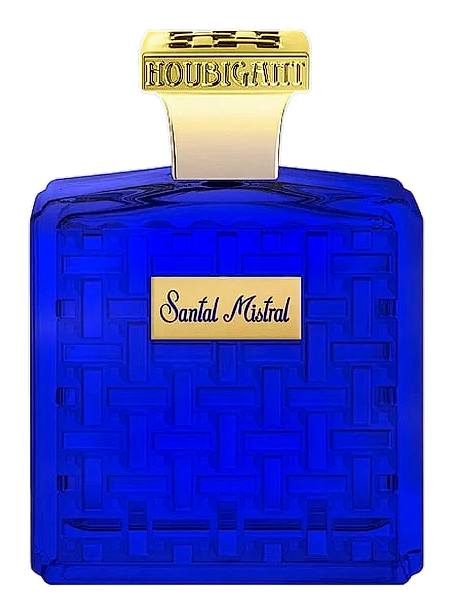
Santal Mistral is part of Houbigant's Côte d'Azur collection, a series built around the sensory register of the French Riviera. The fragrance draws its name from two anchors: santal, the sandalwood that anchors the base, and mistral, the name itself carrying the suggestion of coastal wind and weathered elements. The result is a composition that smells like wood that has been weathered by years of sun, salt, and wind. Launched in 2026, with the scent marketed by Perris Group, the composition was conceived as an ode to sunset on the coast. Not the postcard version, but the moment the heat breaks and the light turns golden and everything goes quiet.
What makes the structure interesting is how Houbigant stacks its woods. Sandalwood leads the base, flanked by Java vetiver in the lower register and cedarwood working through the heart, giving the composition a layered timber architecture. The labdanum and patchouli in the middle add a sticky, resinous warmth that grounds the woods in something animalic and lived-in, while immortelle at the top introduces a maple-like sweetness that keeps the composition from feeling austere.
The evolution
The opening belongs to immortelle. That curious, maple-curry sweetness sits on top of everything, almost shouting. It can feel loud, a little one-note, like the fragrance hasn't figured out what it wants to be. Then the labdanum and patchouli arrive and the whole composition pivots. The sweetness doesn't disappear, it gets absorbed into something darker and stickier. As the hours pass, the cedarwood has settled in and the woods begin to feel like a single material rather than a list. The drydown is a sandalwood and vanilla close that reads warm and intimate. On fabric the next morning, the sandalwood is the last thing standing, still faintly sweet, still faintly resinous, like driftwood that's been kept in a warm room. The transition from the assertive opening to the quieter base notes gives the fragrance a narrative quality, moving from brightness to depth over the course of a wearing.
Cultural impact
Wearers who respond to Santal Mistral tend to describe a complete, almost edible wood composition, the kind that earns repeat wear. Others find the immortelle opening too assertive or the overall impression too synthetic. The composition offers a particular kind of sweetness, one built from resin and warm spice rather than smoke, and that choice gives it a distinct place among woody fragrances. The immortelle opening polarizes, some find its maple-curry brightness captivating, others find it overwhelms the more restrained base.