The Story
Why it exists.
The beginning
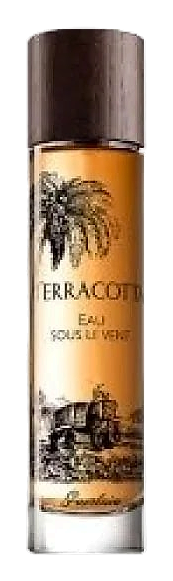
Terracotta Eau Sous Le Vent launched in 2009 as part of Guerlain's Terracotta line, the house's ode to sun-kissed skin and the rituals of summer. The formula was composed by perfumers Christine Nagel and Julie Massé, and it places tiare at the center of a fragrance built around creamy, skin-like warmth. "Sous le Vent" translates to "under the wind," a reference to the leeward side of an island, the sheltered face where the breeze arrives last and the air carries a different quality than the windward shore. Within the Terracotta universe, the scent extends the line's tanning-focused body care ritual, which includes products featuring a Tan Booster Complex.
Tiare is one of perfumery's more unusual solo acts. It carries a milky sweetness without ever tipping gourmand, a coconut-adjacent creaminess that reads more like skin than dessert. In this composition, the tiare sits within a broader accord that includes coconut, bergamot, ylang ylang, jasmine, orange blossom, vanilla, and musk. Rather than building a dense tropical bouquet around the flower, the formula allows the supporting notes to do their own work.
The evolution
On skin, Eau Sous Le Vent opens with tiare's creamy sweetness already established, soft and immediate rather than building from anything sharp. There's no citrus jolt, no sparkling entry, just the flower arriving like it was already there. The tiare holds center early on, warm and lactonic, with a powdery haze drifting around it that keeps everything gauzy rather than dense. That powdery accord, which comes through in the jasmine and the soft musk beneath, keeps the sweetness lifted and slightly cool, preventing the creaminess from settling into anything too rich. As the fragrance wears, the sweetness recedes gradually. What replaces it isn't a new note so much as a shift in temperature, cooler, more skin-like, as though the fragrance is settling into the wearer instead of sitting on top.
Cultural impact
Eau Sous Le Vent holds a distinctive place within Guerlain's Terracotta range, the line the house built around bronzing rituals and the sensory language of summer. The scent shares that lineage with the rest of the Terracotta family, extending the collection's focus on sun-warmed skin into fragrance form. As a body-mist format, it occupies the more casual, everyday end of Guerlain's offering, the kind of scent designed to be reapplied rather than preserved, to be worn on a hot afternoon rather than saved for an occasion.
The House
GuerlainGuerlain stands as one of the oldest and most revered perfume houses in the world, founded in Paris in 1828 by Pierre-François-Pascal Guerlain. What began as a boutique on rue de Rivoli quickly became the preferred destination for Parisian society, attracting dandies and elegant women who sought custom-crafted fragrances. The house's influence grew to such heights that Guerlain earned the title of Official Perfumer to Napoleon III after presenting Eau de Cologne Impériale to Empress Eugénie as a wedding gift in 1853. This royal patronage marked the beginning of Guerlain's enduring association with European aristocracy, as the house went on to create fragrances for Queen Victoria and Queen Isabella II of Spain. Today, under the creative direction of Thierry Wasser, the fifth-generation perfumer, Guerlain continues to shape the landscape of fine fragrance with a portfolio spanning over 1,100 olfactory creations. The house remains headquartered at its legendary Champs-Élysées mansion, a historic monument that anchors Guerlain's position at the intersection of heritage and contemporary luxury.
The Creator
Christine NagelNagel occupies a distinctive space in contemporary perfumery, favoring sensual, textured compositions over the clean minimalism that dominated for decades. Her fragrances often feature unexpected contrasts: mineral and floral, salty and sweet, cool and warm.