
The Story
Why it exists.
The beginning
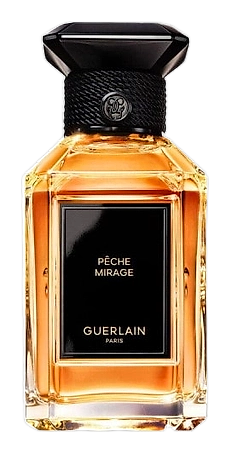
Delphine Jelk created Pêche Mirage for Guerlain's L'Art & La Matière collection, a line built for compositions that refuse the expected. Rather than a straightforward study in peach, she constructed a fragrance about contrast, one where fruit and leather operate as opposing forces brought into conversation through careful craftsmanship. The L'Art & La Matière line exists for exactly this kind of unconventional territory, compositions too distinctive for mass appeal yet grounded in true savoir-faire.
The note selection creates deliberate tension. Peach and Blackcurrant suggest brightness while Leather proposes darkness, and Osmanthus serves as the connective tissue between these opposing forces. Rather than a simple progression from fresh to warm, the fragrance reshapes how each note reads against its companions. Saffron grounds the opening in warmth that prevents the fruit from reading as frivolous, just as the Sandalwood in the drydown softens what could otherwise be an aggressive leather presence.
The evolution
The opening bursts with Peach and Blackcurrant, their combined effect creating tart clarity that resists any easy sweetness. Saffron enters almost immediately, its warm-spiced quality adding medieval depth to an otherwise modern composition. This initial phase establishes a tension between opposing forces that plays across the entire wear. As time passes, Osmanthus takes the stage, bridging the opening and drydown with its distinctive apricot-flor floral character. Finally, Leather emerges as the counterargument, joined by Amber and Sandalwood to close the arc with warmth and subtle animalic presence.
Cultural impact
Pêche Mirage enters a landscape where peach-forward fragrances often lean into straightforward sweetness, yet this composition takes a different approach by anchoring the fruity opening with osmanthus and grounding it in leather. The choice of osmanthus is particularly significant for Western audiences, as the apricot-floral material carries deep cultural weight in Chinese and Japanese traditions but remains underrepresented in mainstream Western perfumery. Osmanthus brings an unexpected complexity that elevates the peach beyond simple fruitiness, creating a bridge between Eastern olfactory traditions and Western fruity fragrances.
The House
GuerlainGuerlain stands as one of the oldest and most revered perfume houses in the world, founded in Paris in 1828 by Pierre-François-Pascal Guerlain. What began as a boutique on rue de Rivoli quickly became the preferred destination for Parisian society, attracting dandies and elegant women who sought custom-crafted fragrances. The house's influence grew to such heights that Guerlain earned the title of Official Perfumer to Napoleon III after presenting Eau de Cologne Impériale to Empress Eugénie as a wedding gift in 1853. This royal patronage marked the beginning of Guerlain's enduring association with European aristocracy, as the house went on to create fragrances for Queen Victoria and Queen Isabella II of Spain. Today, under the creative direction of Thierry Wasser, the fifth-generation perfumer, Guerlain continues to shape the landscape of fine fragrance with a portfolio spanning over 1,100 olfactory creations. The house remains headquartered at its legendary Champs-Élysées mansion, a historic monument that anchors Guerlain's position at the intersection of heritage and contemporary luxury.
The Creator
Delphine JelkJelk builds compositions around contrast and tension—warm, round, and inviting, yet never soft. Her signature leans heavily on iris, musks, and powdery facets that give her work a distinctive texture, like cashmere caught in amber.