
The Story
Why it exists.
The beginning
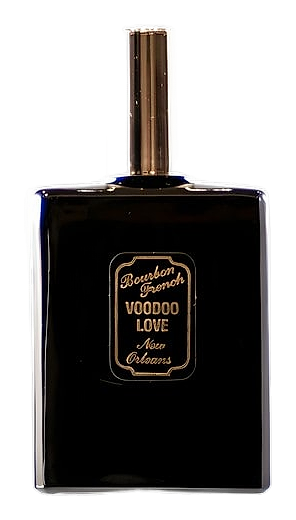
Perfumer Alessandra Crain created Voodoo Love in 1970, at a perfumery that had been hand-blending formulas on the same Royal Street corner since before the Civil War. The name wasn't decoration. New Orleans has always had a reputation for being the place where the veil thins, where herbal knowledge, spiritual practice, and outright enchantment have never been far from each other. Crain drew from that register deliberately. The fragrance doesn't wink at it. It simply behaves like something that knows its own power.
What makes the structure unusual is the absence of the expected Oriental playbook. There is no heavy oud, no overload of white florals. Instead: lilac, a note that behaves differently depending on its source, here lending an aromatic greenness that sets the whole composition apart from standard amber-vanilla territory. The earthy heart (vetiver leading, with supporting smoky warmth) gives it weight without density. Cinnamon adds a spice that prickles rather than comforts. Vanilla is present in both heart and base, but it never becomes the loudest voice in the room. The composition earns its 8.2 scent rating by being specific rather than simply strong.
The evolution
The opening hits within seconds, lilac asserting itself with an aromatic intensity that some wearers describe as almost oily, almost dizzying. Thirty minutes in, the earthiness takes over. Vetiver anchors the composition while amber and cinnamon warm the transition. This is not a subtle hand-off. The heart arrives with presence, spicy and rich, the kind of phase that earns comments from strangers or the occasional raised eyebrow in a closed room. The vanilla in the base eventually softens everything, but it takes its time, three to four hours before the drydown fully settles into something creamy and intimate. On fabric, it lingers longer. The next morning, there's a faint trace of earth and warmth that doesn't quite disappear.
Cultural impact
Among Bourbon French's offerings, Voodoo Love occupies a specific niche, wearers who seek something that smells like its place of origin rather than like a perfume. The earthy-animalic register appeals to those who've moved past safe blind buys and want something with a point of view. Community reviews describe it as almost dizzying in its richness, with one wearer connecting it specifically to the atmosphere of New Orleans itself, muggy days, cool interiors, the layered sensory history of the city. It remains in continuous production, a signal that there's an audience that keeps returning.