
The Story
Why it exists.
The beginning
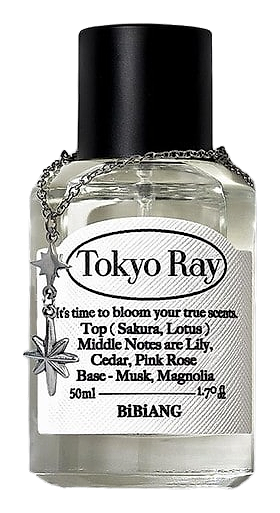
Tokyo Ray arrived in 2025 as part of BiBiANG's catalogue, a release that places Japan's capital inside the house's growing list of city-rooted names. Its composition sits within the floral-woody register that feels like the brand's natural register, leaning on a quiet balance between petal softness and a clean wooden base beneath. The fragrance reads as BiBiANG's considered take on a Japanese city seen through scent, less about tourist iconography and more about the texture of a particular kind of light and stillness. It extends the brand's vocabulary past previous releases into a new locale, carrying the same restraint the label has made a quiet signature of without ever tipping into preciousness or overstatement.
The composition leans on a structure worth lingering over: bright, almost aqueous top notes that settle gently into a woody core. Cherry blossom and lotus form a delicate, almost aquatic opening that sets the emotional temperature before the heart takes over. Cedar does the structural work in the middle, giving the florals something to rest against rather than letting them float untethered. Magnolia in the base adds a creamy warmth that keeps the whole thing from feeling cold or distant.
The evolution
The opening is the quietest part. Cherry blossom and lotus arrive in a wash of cool, watery light, almost ozonic, the olfactory equivalent of a glassy surface reflecting sky. Cedar steps in early and adds a faint dryness underneath the florals, its grain just present enough to ground the petals without competing with them. Lily and pink rose take over the heart and bring a soft, slightly sweet fullness that feels warmer than the opening promised, the roundness of those blooms filling in the space between cedar's architecture. Slowly, the composition shifts from transparent to creamy. Magnolia rounds out the base and musk softens everything further, leaving a close, powdery trace that lingers on skin well into the evening.
Cultural impact
Tokyo Ray fits BiBiANG's pattern of named places turned into scent, joining a catalogue that includes New York In Tilly and Walnut Creek Green. The fragrance reads as the brand's floral entry into that catalogue, one that asks for attention rather than commanding it. It sits closer to skin than to air, an intimate register that suits the way BiBiANG has tended to build its quieter releases. The ozonic opening and cedar backbone keep the scent from drifting into sweetness alone, lending it a structural restraint that feels deliberate, controlled, more interested in finish than flourish.