The Story
Why it exists.
The beginning
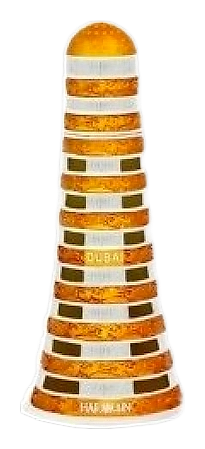
Burj means tower in Arabic. The name alone suggests height and the way certain fragrances seem to build upward, from base to apex. Perfumer Francisco Carbonnel approached this composition with that vertical architecture in mind, layering materials so that each phase arrives with intention rather than arriving all at once. The brief appears to have been floral-oriental, but one that didn't follow the obvious path. Instead of leading with heavy resin or dense oud, Carbonnel let saffron and geranium carry the opening. Incense threads through the heart. Only in the base does the oud fully announce itself, anchored by sandalwood and amber. The tower's foundation is the last thing you smell. Carbonnel is known for work that balances oriental richness with Western wearability, and Burj fits that profile. It carries the warmth expected from an Arabian house without demanding the wearer adapt to it.
What makes Burj structurally interesting is the relationship between the saffron-geranium opening and the oud-sandalwood base. Saffron is inherently sweet and metallic at once. Geranium is cool, green, and slightly medicinal. Together they create an opening that is neither purely warm nor purely fresh, it occupies a middle register that most floral-orientals skip over entirely. The incense doesn't arrive all at once. It builds slowly as the geranium fades, which means the transition from top to heart is nearly seamless. By the time the oud arrives in the base, the skin has already been warmed by several hours of quiet smoke.
The evolution
The opening hits fast. Saffron arrives with its signature sweet-metallic burst, the kind that reads almost as a spice in the air. Within two minutes, geranium arrives cool and green beneath it. The combination is unusual, bright, almost soapy, with a hint of something herbal. Incense smoke begins to rise within five minutes, not heavy, just present. By the half-hour mark, the floral notes have fully opened. The incense thickens slightly. The geranium's green quality softens, becoming more aromatic than sharp. This is the heart phase, and it lasts. For two to three hours, Burj maintains this warm-smoky-floral character without significant drift. The base announces itself gradually. First sandalwood, creamy and warm. Then the oud arrives, resinous, dark, but not aggressive. It doesn't overtake the composition. It deepens it. Amber adds warmth, and the whole thing settles into the skin for a slow, quiet drydown that can last 6-8 hours on most skin types. On fabric, the drydown extends further.
Cultural impact
Burj occupies an interesting position in the Al Haramain range, floral-oriented in a house known primarily for bold oud statements. Community reviews describe it as an interesting scent composition with moderate sillage, praised for its fresh green-floral character mixed with amber warmth and a delicate smoky note. The incense and smoky quality give it personality for those seeking something beyond safe oriental territory.
The House
Al Haramain PerfumesAl Haramain Perfumes is a fragrance house rooted in Mecca, Saudi Arabia, with over five decades of experience crafting oriental perfumes. The company traces its origins to 1970, when founder Kazi Abdul Haque, a Bangladeshi businessman, began trading perfumes with shops in Makkah and Madinah before moving into production. Today, the business operates from the UAE under the leadership of Haque's eldest son, Mahtabur Rahman, who serves as Chairman and Managing Director. Al Haramain has built a portfolio that reportedly exceeds 1,000 fragrance variants, spanning pure perfume oils, concentrated sprays, bakhoor, and agarwood products. The brand maintains retail presence across the GCC, Middle East, Asia, and Europe through a network of exclusive stores. Notable releases include Dehnal Oudh Mahabbah from 2012, Red African from 2017, Mukhamria Maliki Silver from 2021, and the Musk Orchid and Musk Floral releases of 2023.
The Creator
Francisco CarbonnelFrancisco Carbonnel's signature techniques reflect a deep engagement with Spanish olfactory traditions, particularly the warm, resinous materials that define that region's contribution to perfumery. He works extensively with oriental bases, though his interpretation leans towa…