
The Story
Why it exists.
The beginning
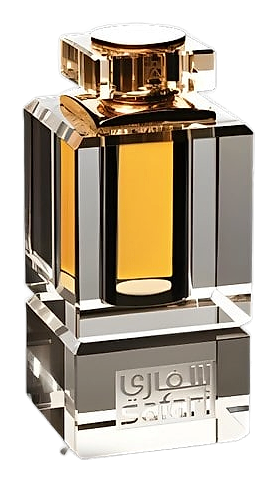
The name translates to "King of Perfumes." Abdul Samad Al Qurashi sits squarely within Arabian perfumery's oud and amber lineage, and Malik Al Atoor draws directly from that core vocabulary. The composition distills four essential pillars: agarwood, Taif rose, amber resin, and musk. There's no citrus to brighten the top, no aquatic accord pulling things toward fresh and clean, no sweetness dialed in for easy accessibility. What you get instead is a concentrated blend that stays inside the tradition it comes from, letting each material speak in its own register rather than smoothing everything into a single commercial chord.
What makes this composition worth attention is what it leaves out. No citrus opening, no modern aquatic accord, no sweetness engineered for mass appeal. Just four pillars: agarwood, amber, Taif rose, and musk. The rose here is the Taif varietal, and it carries a depth that distinguishes it from brighter, more familiar florals. Where many rose compositions aim for luminous petal freshness, this one pushes toward something warmer and more textured, a rose that has weight rather than air.
The evolution
The opening leans entirely on oud and amber, a dense resinous wall that reads more ceremonial than wearable. There's no traditional opening act here, no bergamot or citrus to ease you in. Just the wood and the resin, doing what they do. The agarwood dominates from the first spray, smoky and dense, with the amber wrapping around it in a way that gives the composition warmth without any brightness or lift. The two materials share so much DNA that they read almost as a single force in the first minutes, a heavy resinous accord that announces itself without apology. As the composition moves forward, the Taif rose surfaces, but it doesn't bloom the way Western florals do. It comes through as warmth, not sweetness, a quiet undertone that settles beneath the oud rather than cutting across it.
Cultural impact
Malik Al Atoor draws directly from Arabian perfumery's core tradition, using agarwood, amber, Taif rose, and musk as its entire material vocabulary. That's a deliberate choice, and it places the composition firmly within a specific lineage of Arabian perfumery rather than the broader landscape of commercial fragrances. The four-note structure keeps the composition austere by modern standards, where extended pyramids with a dozen or more materials have become the norm in both Western and Middle Eastern launches. Here, every note carries weight because nothing is diluted across a larger cast.