
The Story
Why it exists.
The beginning
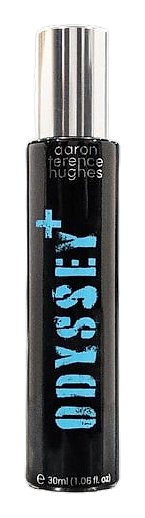
Odyssey arrived in 2016, five years into Lesli Wood Peterson's experiment in scent-as-narrative. The name came first, a deliberate nod to the Kubrick film and its prehuman dawn, the stretch from instinct to idea. Peterson wasn't interested in replicating the movie's cold vastness. She wanted its arc: the long motion from raw beginnings toward something luminous and strange. The vinyl note became the through-line. Not retro kitsch, not futuristic plastic, something in between. The smell of recorded sound, of media that holds memory. Of information made tactile.
What makes Odyssey unusual is the combination of warm and cool. Amber brings sweetness, depth, the kind of resinous warmth that feels ancient. Vinyl brings something else entirely, synthetic, almost mineral, a faint edge that keeps the sweetness from becoming soft. These two shouldn't work together, and yet the styrax (liquidambar) acts as translator. Its balsamic quality bridges the gap, making the warm and the cool feel like a single conversation rather than competing notes. The result is a fragrance that smells like it belongs to a specific time and no time at all.
The evolution
The opening hits like recycled air, the smell of something breathing again. A brief sharp moment, then the amber swells and the vinyl softens into it. The transition takes about twenty minutes. By the time you're settling into the heart, the fragrance has become warmer, denser, the spice lifting while the balsamic base stays close to skin. This is when it reads as intimate, sillage becomes moderate, projection quiet. The drydown holds for hours. Amber and styrax, still present but quieter, more private. On fabric the next morning: faint warmth, like a memory you can't quite place.
Cultural impact
Odyssey occupies an unusual position in the niche landscape: a fragrance named for Kubrick's film but refusing to smell like it looks. No cold space, no sterile metal. Instead: warmth, memory, and an edge of something that could be antiquity or could be future. The people drawn to it tend to be those who read fragrance as text rather than decoration, wearers who want their scent to say something.