The Story
Why it exists.
The beginning
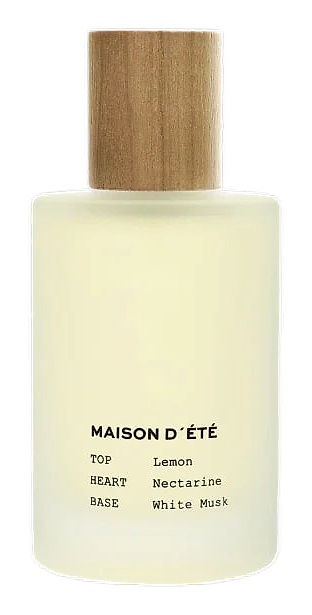
Zara built the 2026 release of Maison d'Été to bottle the feeling of stepping out of a summer house. The composition opens with lemon, bright and unmistakable, the kind of citrus that cuts through humid air and clings to warm skin. It announces itself without shouting, a sharp little jolt that makes you pay attention before it softens. Nectarine takes over in the heart, sweet but grounded, carrying that fuzzy stone-fruit quality that feels like late August rather than early summer. White musk anchors the base, clean and close, the kind of drydown that leaves a trail just a few inches from the skin rather than filling a room. The whole thing reads as a single gesture, not a layered construction. Nothing competes for attention. Nothing tries to be more than the sum of its three notes.
What makes this composition worth noticing isn't its complexity. It's the absence of complexity. Three notes doing three jobs, and none of them reaching for attention. The lemon is straightforward, citric and bright, without trying to evoke any particular grove or orchard. The nectarine is sweet without being candy, fuzzy without being overripe, sitting in that perfect zone where fruit smells like fruit and nothing else. The white musk is the workhorse, the kind that sits close to skin and never projects beyond arm's length. Each note has a clear role, and none of them step on the others.
The evolution
The first 15 minutes belong to lemon, sharp and almost bracing, the way citrus smells when it hits warm skin rather than a cold glass. It doesn't last long. Within half an hour the nectarine takes over, but it doesn't arrive as fruit. It arrives as sensation. Soft, slightly fleshy, with a powdery edge that signals the musk is already building underneath. The transition happens without a seam, one note sliding into the next like a slow exhale. By the two-hour mark the fruit is mostly memory, though its sweetness lingers as a faint suggestion of stone-fruit skin. The white musk holds the rest of the wear, sitting close to the skin in that freshly-washed-linen register the brand describes directly. The musk doesn't shift or evolve much on its own, but it changes shape depending on what's underneath it. On dry skin it stays quieter.
Cultural impact
Maison d'Été sits firmly in the skin-scent category that has come to define recent summer fragrance releases, a register where the goal is intimacy rather than projection. Wearers describe it as a beach-bar-in-Greece scent, an escape rather than a statement. It's the kind of fragrance you reach for when you want to feel like you're somewhere else, even if you're just walking home through the city. The category itself has grown crowded, with lighter compositions flooding the market every summer, but this one earns its place by knowing exactly what it wants to be. It won't shift the fragrance conversation, but it wasn't trying to.