
The Story
Why it exists.
The beginning
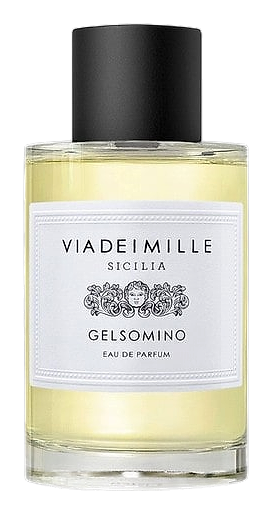
Gelsomino is VIA DEI MILLE's opening statement, named for the flower that defines Noto's surrounding countryside. The brief was simple: jasmine, Sicilian jasmine, without apology. Jacques Chabert and Nathalie Koobus built the composition around that singular material, layering it with the crispness of mandarin, the green cut of violet leaf, and the powdery depth of iris to give the white floral somewhere to live beyond its first hour. The result is a fragrance that arrives bright and stays bright, trading the usual indolic depth of jasmine for something cleaner and more sustained. The name carries its own meaning. "Gelsomino" is how Sicilians say jasmine, the same word, the same flower, but spoken with an accent that belongs to a specific hillside and a specific light. This is jasmine as territorial marker, as proof that a place has a smell and that the smell can be bottled.
What looks like a simple six-note list hides something more interesting underneath. Jasmine and mandarin orange bookend the composition with bright, clear intention, but the middle passage is where things get unusual. Violet leaf, usually a supporting actor in the opening, appears in the heart alongside iris flower. Vetiver, typically a base material, anchors the middle too. The result is a jasmine that never fully commits to sweetness. There's always a green thread running through it, an earthy counterweight that keeps the white floral from becoming something you'd call "pretty" and instead makes it something you'd call "alive." Mysore sandalwood enters late but contributes disproportionately to the drydown.
The evolution
The opening arrives quickly. Mandarin orange, bright, clean, citrus-forward, establishes the first thirty seconds with no ambiguity. Then jasmine steps in and doesn't leave. Violet leaf follows, adding a green, slightly metallic cut that prevents the white floral from becoming precious. The heart phase lasts longest on skin, maybe three to four hours, where the jasmine and violet leaf exist in productive tension with the earthy vetiver starting to assert itself. The sandalwood appears around hour two and becomes the dominant feature of the drydown. Not replacing the jasmine, it never fully leaves, but working alongside it, adding creaminess and warmth that makes the final hours feel intimate rather than loud. The projection drops to moderate, the sillage becomes close, and what was a daytime brightness settles into something more personal. Eight to ten hours later, the skin still carries a trace of jasmine and sandalwood together, faint but unmistakable, the signature of someone who wore this and meant it.
Cultural impact
Gelsomino occupies a distinct position in the white floral landscape, offering jasmine without the polarizing extremes that define so many contemporaries. It refuses the indolic push that makes some interpretations challenging, yet it equally avoids the diluted, skin-close approach that renders jasmine anonymous. For collectors who understand the difference between the flower itself and its various interpretations, the vetiver backbone provides genuine intrigue. The composition's clean structure adapts across seasons, lending itself to any moment where quiet confidence reads louder than obvious sillage.