
The Story
Why it exists.
The beginning
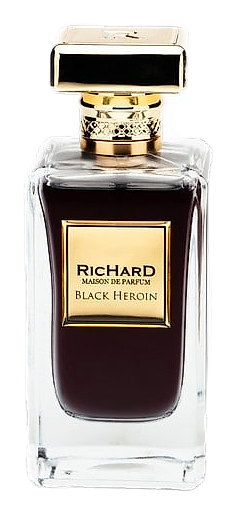
Richard's catalog reads like a series of questions the founder couldn't stop asking: What if sweet went too far? What if dark had a sense of humor? What if a fragrance named itself after the thing people crave most? Black Heroin arrived in 2020 as the answer to that last one, not a shock value gesture, but a genuine inquiry into what makes a scent feel necessary rather than just nice. The name suggests heaviness, but the composition moves in the opposite direction: light, almost sheer, built for intimacy rather than announcement.
The structure is quietly unusual. Most fragrances that promise addiction lean into density, thick vanillas, sticky resins, animalic musks that coat the air. Black Heroin takes the opposite path. It opens crisp with citrus, lets violet and rose breathe in the heart, and arrives at patchouli and amber only after the skin has warmed to it. That sequencing matters. The addiction isn't immediate, it builds. By the time the musk arrives, you've already been wearing it for an hour and can't remember what you smelled like before.
The evolution
The first thirty minutes are all citrus brightness, bergamot and lime cutting clean through, like a window thrown open in a dim room. Then the violet enters, shifting the register from sharp to soft. The rose doesn't announce itself. It floats underneath, lending body without sweetness. The patchouli arrives around the one-hour mark, cooler than expected, almost mineral in its dryness. By hour two, the amber and musk have settled into skin, close, warm, present without projecting. This is not a fragrance that fills a room. It's a fragrance that someone standing near you will want to lean toward.
Cultural impact
In a fragrance landscape that often trades in aggression, loud projections, excessive sillage, the performative confidence of oud and leather, Black Heroin takes a contrarian position. It whispers. The 2020 launch arrived at a cultural moment when consumers were increasingly interested in intimacy over announcement, in scent as personal ritual rather than social signal. Richard understood something that larger houses were slower to act on: the most addictive fragrances are often the ones that don't announce themselves.