
The Story
Why it exists.
The beginning
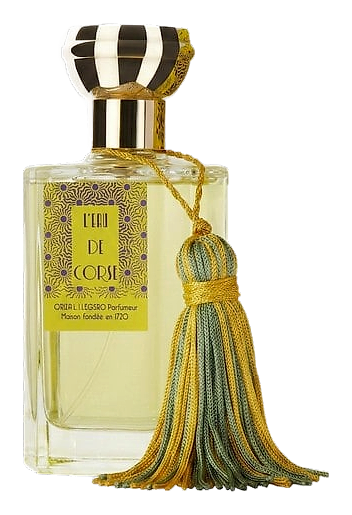
L'Eau de Corse takes its name from the Mediterranean island of Corsica, a French territory known for its wild, sun-drenched landscapes and the bitter orange trees that grow along its rocky coastlines. The fragrance was composed in 1937, a period when colognes were expected to do real work: cut through tobacco smoke, survive a long dinner, outlast the evening without reapplication. The brief wasn't modern freshness. It was composure under pressure.
What makes L'Eau de Corse unusual is its structural logic. Most colognes are top-heavy, one bright moment, then silence. This one builds around Corsican bitter orange as both top and base, creating a circular architecture where the signature material returns in the drydown. Mint bridges the opening and heart, amplifying the cool while oakmoss adds the green, almost forest-floor weight that prevents the whole thing from evaporating. It's a formula that thinks in hours, not minutes.
The evolution
The lemon and mandarin hit first, bright and aldehydic in a way that reads distinctly pre-war. No rounded edges or synthetic smoothness, the opening has teeth. Within minutes, the Corsican bitter orange asserts itself, joined by mint's cool. The aldehydic quality softens the citrus, giving it a slightly powdery, antique warmth. By the second hour, the heart settles and the oakmoss arrives, grounding the composition with something earthier, almost mineral. The bitter orange doesn't disappear, it deepens, taking on a resinous quality as the green base rounds beneath it. By the fourth hour, you're left with oakmoss, a ghost of bitter orange, and the faint warmth of the aldehydic thread still clinging to skin.
Cultural impact
L'Eau de Corse occupies a specific position in the fragrance landscape: cologne as artifact. Wearers describe it as the scent of someone who walks into a room and doesn't need to announce themselves. The aldehydic quality and oakmoss base place it firmly in the classical chypre-cologne tradition, making it an outlier in an era of aquatic and ambroxan-driven freshness. Those who gravitate toward it tend to be collectors or enthusiasts seeking something that smells intentional rather than designed for mass approval.