
The Story
Why it exists.
The beginning
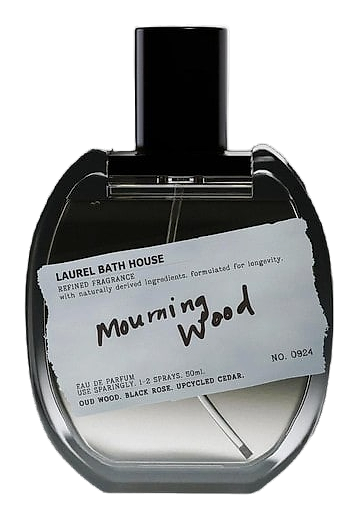
Laurel Bath House launched Mourning Wood in 2025 as part of its Functional Fragrance collection. The name carries a certain weight, calling back to Laurel's habit of naming scents with a wink and a nudge, but the composition underneath plays it straight. This is the brand's quieter gesture: oud and mahogany dressed up in black rose, built for the wearer who wants depth without spectacle. The Grounding subtitle signals intent. Where other entries in the lineup lean playful or magnetic, Mourning Wood is calibrated to settle rather than spark. It reads like an everyday piece of the fragrance wardrobe: something present enough to notice in your own reflection, restrained enough to wear again tomorrow without anything feeling overfamiliar.
What makes Mourning Wood structurally interesting is the placement of oud and mahogany in the heart rather than the base. The black rose and lily of the valley handle the arrival, lifted and slightly green, and then hand the floor to woods that carry weight. That inversion does something specific. The florals get to breathe at the top without competing with the dense materials, and a warm spicy patchouli-oud accord emerges in the middle with uncommon clarity.
The evolution
Mourning Wood opens with a cool floral gesture: black rose tinted slightly bruised, lily of the valley adding a green sweetness that reads almost dewy. The florals do not linger in the foreground. Oud surfaces with a dry, resinous character, joined by mahogany's polished warmth and patchouli's earthy insistence. The shift is noticeable. The fragrance that arrives in the heart phase feels structurally different from the one you sprayed, and the transition has a tactile quality, almost like watching a painted surface change under different light. The drydown is where cedar and sandalwood take over, softened by whatever trace of rose and oud survived the transition. The result is creamy and understated, a woody skin-scent that registers more to the wearer than to a room. Whatever the final stretch of wear holds, the cedar and sandalwood do most of the talking.
Cultural impact
The composition underneath the name speaks to a wearer who wants substance without theater. Mourning Wood uses oud in a way that keeps it wearable for daily rotation rather than saving it for ceremony. The black rose and lily of the valley open the door with a floral lift that doesn't overpower, and the drydown of cedar and sandalwood keeps the whole thing grounded in something familiar and skin-like. It wears lightly enough to repeat without fatigue, and the materials that could read heavy in another arrangement come across as polished and controlled here.