The Story
Why it exists.
The beginning
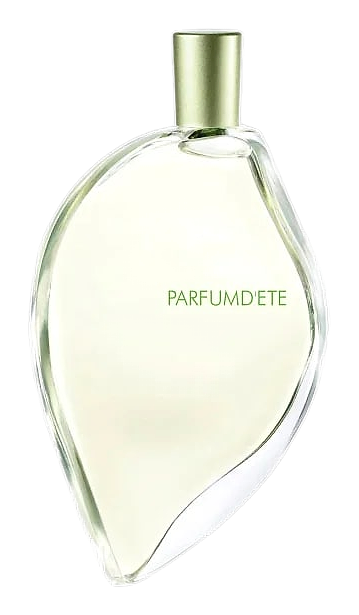
Kenzo released Parfum d'Été in 1992, a green floral Eau de Parfum that the perfumers, Antoine Lie and Jean-Claude Delville, composed to capture the greenest, most alive moment of a garden. The name itself signals the intent: a fragrance built around the season rather than around any single bloom. The composition opens with a single-leaf accord, the greenness of foliage before flowers take over, then moves into a bouquet of soft white florals, and finishes on a clean sandalwood-musk base that feels like skin after sun. Serge Mansau designed the bottle, shaped like a leaf itself, limpid and simple, holding the green liquid like a cupped palm.
What makes Parfum d'Été interesting is the choice to lead with Lily of the Valley leaf rather than the flower itself. The fragrance starts at the stem, the green part, the chlorophyll before the bloom. That single decision shapes the whole composition. The heart still delivers peony, jasmine, and hyacinth, but they arrive filtered through that initial greenness, so they read as a garden in motion rather than a bouquet in a vase. The green opening never fully leaves either; it keeps threading through the white florals, keeping them cool and slightly translucent.
The evolution
The first thirty minutes are where Parfum d'Été makes its argument. The Lily of the Valley leaf opens with a sharp, almost vegetal green, cool and assertive, like the smell of foliage right after rain. There's nothing sweet here, nothing polite. It's the smell of growing, not the smell of blooming. Around the forty-minute mark, the peony and jasmine start to soften the edges. Hyacinth adds a watery, slightly peppery green that bridges the opening and the heart, preventing the florals from ever feeling creamy or heavy. The white florals carry through the middle hours without ever pushing forward. This is not a perfume that demands attention from across the room. By hour four, the sandalwood emerges underneath, giving the florals a faint woody backbone.
Cultural impact
Parfum d'Été arrived in 1992 as a green floral with a clear seasonal concept. The original Eau de Parfum was followed by an Eau de Toilette version and a 2002 reformulation, each one interpreting the same core idea with slight shifts in balance and brightness. Wearers tend to describe it less as a statement fragrance and more as an atmosphere, something that makes the wearer feel like they're in a garden rather than wearing a perfume. The bottle's leaf shape became one of the more recognizable flacons of the early 1990s, and the green juice visible through the clear glass reinforced the theme before the scent even hit skin.