
The Story
Why it exists.
The beginning
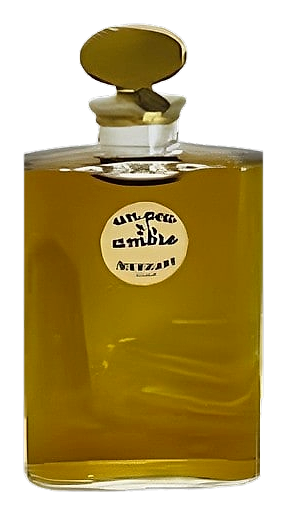
Un Peu d'Ambre launched in 1919, at the close of a world reordered by war. The name translates plainly: a little amber. Not a statement, a suggestion. The composition holds to that economy of language with remarkable discipline. There is no bright citrus to lure you in, no floral scaffolding to prop things up, no sharp aromatic to cut through the quiet. What you get is the thing itself, distilled and presented without ceremony. Ambergris offers its cool, mineral undertow, a saline coolness that grounds the warmer notes. Amber brings the resinous glow, the almost-golden sweetness that feels like light falling through old glass. Together they form a conversation between two facets of a single idea, and that simplicity is where the composition lives or dies.
The composition is a study in restraint. Ambergris and amber, and little else. No floral scaffolding, no citrus opening to charm you in. Just two facets of the same material, each pulling in a different direction. Ambergris brings the oceanic, mineral edge, that salted quality familiar from its natural origins. Amber brings the warmer, resinous, almost golden sweetness. Together they create a conversation between two versions of one thing. That economy of materials is the point.
The evolution
From the first spray, there is no fanfare. The ambergris surfaces immediately, carrying a cool, almost briny weight that reads more like sea-washed stone than perfume. Within the first twenty minutes the amber begins to assert itself, warming the composition from within, introducing a faint resinous sweetness that sits underneath the salt rather than on top of it. The transition is not dramatic, it is incremental, like watching a fire bank itself. By the two-hour mark the two materials have fully merged into a single, unified warmth that hovers close to the skin. The animalic edge never disappears entirely. It softens, rounds, becomes something you notice when you press your wrist to your face rather than something that announces itself across a room.
Cultural impact
Un Peu d'Ambre occupies a curious place in fragrance history. Launched in 1919, it arrived in the aftermath of one world war and on the eve of enormous cultural shifts that would reshape perfumery for decades to come. Its near-monolithic focus on amber makes it a touchstone for those who study the amber family closely. The composition treats ambergris and amber not as supporting players in a larger cast but as the entire production, each given room to develop without interference from competing materials. For those interested in how amber materials were handled in earlier eras of modern perfumery, this is a significant example.