
The Story
Why it exists.
The beginning
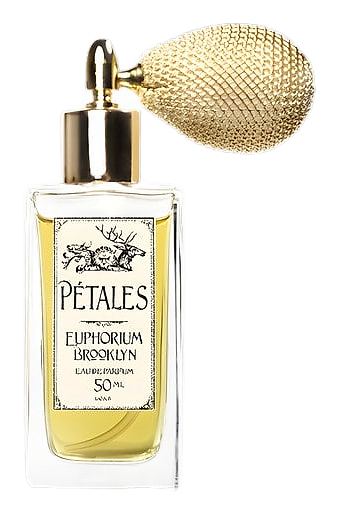
Euphorium Brooklyn's founder Stephen Dirkes built his house on invented history, but Petales feels like something pulled from the records of a real perfumer. This is where the mythology of the fictional Euphorium Bile Works meets the sensibility of a self-taught Brooklyn artist working outside any institutional tradition. Petales takes its name from flower petals, but the accent mark introduces ambiguity, it could be a typo, a flourish, or something else entirely. The fragrance exists in that same productive uncertainty. Dirkes designed this as a green-floral with an animalic undercurrent, built for someone who finds the usual white floral composition too predictable. The idea was to push a familiar genre into stranger territory, beauty and unease held in the same hand.
What makes Petales unusual is its willingness to use indole as a structural element rather than an accident. In jasmine and hyacinth, indole occurs naturally, it's the nitrogenous compound that gives some white florals their characteristic rawness. Here, Dirkes leans into it deliberately, allowing the composition to slide toward something animalic as the top notes recede. The galbanum in the opening reinforces this: it's green in a way that feels almost vegetal, like the crushed stem of a flower rather than a note extracted from it. The honey note is the composition's other defining choice.
The evolution
The opening announces itself without apology. Galbanum and petitgrain arrive sharp, almost aggressive, before pink grapefruit cuts through with a tartness that grounds the green. This phase lasts maybe thirty minutes, the time it takes for the top notes to realize the composition has somewhere more interesting to go. The heart is where Petales earns its name. Hyacinth takes over, its green-soapy floral character softened by honey and the warmer presence of jasmine, rose, and geranium. Lavender appears mid-heart, adding an aromatic twist that keeps the florals from becoming cloying. Violet and fig move in quietly, pushing the composition toward something powdery and sweet without losing the green thread entirely. This phase lasts the longest, two to four hours, and it's the one most likely to start a conversation. The drydown is the tell. Indole emerges as the honey fades, that animalic-floral character that some find unsettling and others find irresistible.
Cultural impact
Petales arrived in a niche perfumery landscape that was beginning to prize animalic rawness over polished florals. The indie community, collectors who tracked indie perfumers on forums and followed Dirkes' Brooklyn-based work, responded to the composition's willingness to use indole as a feature rather than a flaw. It's the kind of fragrance that generates debate: wearers either find it memorably beautiful or quietly unsettling. Both responses are accurate.