
The Story
Why it exists.
The beginning
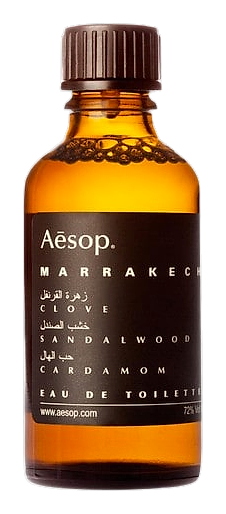
Marrakech arrived in 2005 as Aesop's first fragrance created purely for olfactory pleasure, not for the functional benefits the brand had built its reputation on, but for the singular experience of smell itself. The name points directly to its inspiration: the Moroccan city where heat, spice, and centuries-old trade routes converge in something immediate and transporting. Where other houses might have reached for metaphor, Aesop simply named the place. The idea was straightforward: translate the sensory reality of a spice market into something wearable. Warm air, dried petals, wood smoothed by handling. Complexity without complication. The brief, if there was one, seems to have been restraint, to make something dense and evocative without tipping into spectacle. Cardamom and clove provided the sharp aromatic structure. Sandalwood offered warmth without sweetness. Neroli added a quiet floral undertone that kept everything grounded.
What makes Marrakech unusual is the clove dominance, not as an accent, but as the gravitational center around which everything else orbits. In most warm-spicy compositions, clove appears as a supporting player. Here, it leads. This shifts the entire architecture toward something more assertively aromatic, more medicinal in its opening hours than the typical woody Oriental. The addition of neroli is the subtle differentiator. Rather than allowing the clove and cardamom to build toward pure heat, the neroli introduces a faint citrus-bitter floral that lightens the texture just enough. It never becomes sweet, never becomes soft, but it prevents the composition from becoming heavy.
The evolution
The opening doesn't ease in. Clove arrives immediately, sharp, almost piercing, followed closely by cardamom's green-spicy bite. There's no delay, no softening. For the first twenty to thirty minutes, Marrakech makes its presence known. This is the divisive phase. Some find it commanding. Others find it too much. The sandalwood appears within the hour, threading warmth through the sharpness. It doesn't replace the clove, it contextualizes it, taking what could reads as medicinal and making it feel intentional. The cardamom persists alongside, keeping the aromatic tension alive. Neroli emerges quietly in the mid-phase, adding a faint floral-bitter undertone that prevents the composition from becoming purely warm. By hour two, the spices begin their slow recession. The clove fades first, followed by the cardamom. What remains is the sandalwood, warmer now, creamier, settling close to the skin. The drydown is intimate, woody, and persistent. It stays close without projecting aggressively. On fabric, it can last until the following day.
Cultural impact
Marrakech arrived in 2005 as the inaugural fragrance from a brand better known for botanical skincare than perfume. Its release marked Aesop's formal entry into the fragrance world, a category the brand had approached cautiously, given its philosophical resistance to the industry's seasonal cycles and trend-driven launches. The 2005 date places it in a specific cultural moment: late-era niche perfumery, before the explosion of brand proliferation that would define the 2010s. It carved space for itself by doing something the brand still does, refusing to sound like everyone else. The warm-spicy, clove-forward composition stood apart from the aquatic and fresh fragrances that dominated the mid-2000s mainstream.