Burnt Hair
A daring, conceptual accord that captures the sulfurous, acrid edge of singed keratin. Burnt Hair exists as a synthetic olfactory fiction, a constructed note rather than a harvested material, designed to evoke something primal and unsettling.
Character
How it smells
Singe, smoke, and synthetic fiction.
Burnt Hair is not harvested or distilled. The note is constructed in a lab using pyrolyzed molecules and aroma chemicals that imitate the smell of scorched keratin.
Pairs beautifully with

Origin
N/A (synthetic accord)
Burnt hair as a fragrance concept owes its existence to the broader tradition of olfactory shock in perfumery, a lineage stretching back to the scorched resins of ancient Mesopotamian incense rituals around 2000 BCE. Early cultures burned oils and resins to scent sacred spaces, and the acrid smoke that resulted became part of perfumery's earliest vocabulary.
Modern perfumery only gained access to true burnt-keratin accords after the late nineteenth-century rise of synthetic aroma chemistry, which unlocked sulfurous and pyrolytic molecules previously unavailable to perfumers. Avant-garde houses in the twentieth century began experimenting with animalic and burnt notes, using indole, civet, and castoreum to push boundaries.
The explicit burnt hair accord is a twenty-first-century phenomenon, tied to conceptual and novelty perfumery that treats scent as provocation. It represents a complete inversion of traditional perfumery's floral and gourmand language, replacing prettiness with deliberate dissonance.
Wears it best
Fragrances featuring Burnt Hair
Brands
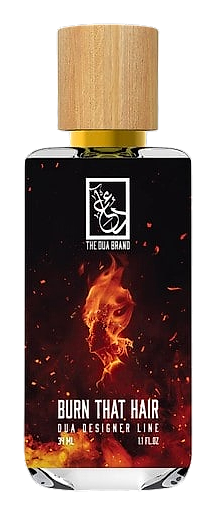
Brands known for Burnt Hair
Good to know
Questions, answered
The essentials on Burnt Hair in perfumery: how it smells, where it comes from, and how it behaves on skin.
What does burnt hair smell like in perfumery?
Burnt hair smells acrid, sulfurous, and smoky, with rubbery, slightly sweet undertones. It evokes scorched keratin and burning protein, an effect perfumers build using synthetic pyrolysis-derived molecules like benzothiazole and select pyrazines.
Is burnt hair a natural fragrance ingredient?
No. Burnt hair is a synthetic accord with no botanical or animal source. Chemists construct it in a lab using aroma chemicals that mimic the smell of pyrolyzed keratin, since natural extraction is impossible.
Which chemicals create the burnt hair effect?
Perfumers typically rely on benzothiazole for its rubbery sulfurous edge and pyrazines for smoky burnt-protein depth. Trace amounts of indole or skatole can add a warm animalic quality.
Why do perfumers use burnt hair accords?
Perfumers use burnt hair accords for conceptual and avant-garde compositions, where dissonance and shock value drive the creative statement. It deliberately subverts traditional floral and gourmand palettes.
When did burnt hair first appear in perfumery?
Explicit burnt hair accords emerged in twenty-first-century conceptual perfumery. The underlying sulfurous and pyrolytic chemistry became accessible after late nineteenth-century advances in synthetic aroma compounds.
Is burnt hair safe to wear as a perfume?
Yes, when professionally formulated within IFRA safety guidelines. The synthetic molecules used are standard perfumery materials, though concentrations must stay low due to their potency.
How is burnt hair different from smoky or leather notes?
Burnt hair is sharper and more sulfurous than smoky notes like birch tar, and more acrid than leather accords built on isobutyl quinoline. It specifically targets the burnt-keratin character.
Can burnt hair be extracted from real hair?
No sustainable extraction method exists. Pyrolyzing real keratin yields inconsistent and unpleasant results, so the fragrance industry relies on laboratory-synthesized alternatives for reproducibility.