The Story
Why it exists.
The beginning
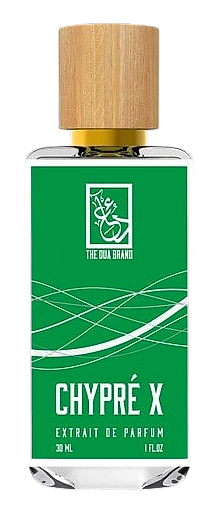
Chypré X arrived in 2018 from The Dua Brand, a house whose catalog tilts toward compositions that borrow heavily from the luxury end of the perfume world. The inspiration sits in plain sight. This is a tribute to Roja Dove's Chypré Extraordinaire, one of the most discussed chypres of the modern era, and the brief was to honor that same architecture. The result keeps the chypre spine intact, bergamot and aldehydes up top, a labdanum-heavy heart stacked with florals, moss and patchouli underneath, plus a generous pour of civet and leather to give the drydown its teeth. The bergamot opens with that bright citrus lift chypres depend on, fizzy and sharp, the aldehydes lending a soapy, waxy effervescence that makes the whole thing feel lit from within.
The chypre genre has always been a structural game, built on a triangle of citrus, florals, and a moss-patchouli-labdanum base. Chypré X respects that skeleton and develops it with conviction. Cistus labdanum anchors the resinous heart, a material that smells simultaneously honeyed, leathery, and faintly animalic, like amber with a pulse. The labdanum here reads less like a clean amber accord and more like the raw resin scraped from a bush in summer, sticky, dark, and slightly medicinal at the edges.
The evolution
The opening belongs to the aldehydes and bergamot, bright and fizzy, almost like a burst of citrus confetti scattered over a layer of cold wax. The aldehydes do their characteristic work in the first phase, lifting the composition, adding that prickly, sparkling quality that makes everything seem aerated and slightly soapy at the same time. Then the aldehydes pull back, and the heart takes over. Rose de Mai, jasmine, tuberose and ylang-ylang arrive in a dense white-floral cluster, warmed by peach and a trace of clove and cumin that adds a savory, almost edible undertone. This is where the composition earns its weight. The florals don't sit pretty.
Cultural impact
Chypré X lives in an interesting corner of the fragrance world. It commits fully to the chypre genre, a category with deep roots in the early twentieth century, one that has long been associated with the structural interplay of citrus, florals, moss, and resin. For wearers who grew up smelling their parents' wardrobes, or who learned about chypres through fragrance history books and vintage perfume references, this is a direct line back to a particular tradition of perfumery.