The Story
Why it exists.
The beginning
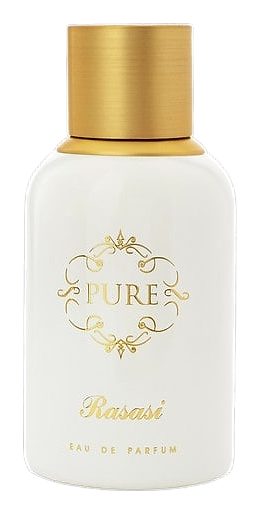
The name says everything and nothing. Pure isn't minimalism as an aesthetic choice, it's minimalism as an argument. Rasasi built its reputation on richness, on the unapologetic weight of oud and saffron and amber. Pure enters the room differently. No excess. No layering for effect. Just what the florals actually do when you let them speak without interruption. The 2022 release reads like the house took a breath and asked: what if we stripped it down to the three flowers we trust most?
Tuberose, honeysuckle, jasmine, a white floral triangle where each vertex does something the others can't. Tuberose brings the creamy, almost narcotic depth. Honeysuckle adds the honeyed sweetness that keeps it from going cold. Jasmine anchors the whole thing in something familiar, something that reads as 'flower' even to someone who's never studied a pyramid. Below them, orris root adds that powdery, violet-adjacent quality that makes florals feel expensive rather than sweet. Sandalwood grounds the composition so the flowers don't float away entirely. It's not a complex structure, but complexity isn't the point. Precision is.
The evolution
The opening hits clean and bright. Tuberose doesn't shy from its own nature here, it blooms immediately, creamy and a touch animalic before the honeysuckle softens it. Within the first hour, the jasmine arrives to steady things. By hour two, the composition has settled into something warmer. The orris root emerges as the florals begin their slow exit, adding powder without dust, sweetness without sugar. The sandalwood holds the base through hour three and four, keeping everything close to the skin. On fabric, the drydown can last into the next morning, a faint, clean trace that smells like nothing but flowers and warmth.
Cultural impact
Pure arrived in 2022 as part of a quiet recalibration in the mass-market fragrance world. The accessible luxury segment was already crowded, but most entries leaned into boldness, sillage, and projection as selling points. Pure argued the opposite. The white floral genre itself carries weight in fragrance culture, evoking vintage compositions and the gardenia-and-tuberose imagery of old Hollywood glamour. Rasasi's version strips that down to its cleanest form. The timing coincided with a broader cultural turn toward restraint in personal style, whether in fashion or fragrance. Pure positioned itself as an option for someone who wanted sophistication without announcement, someone choosing intention over intensity.