The Story
Why it exists.
The beginning
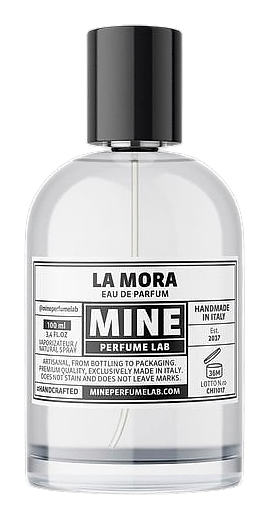
La Mora arrived in 2013 from Mine Perfume Lab, a small workshop that has since built a catalog organized around narrative naming. The fragrance sits among the early statements in the house's archive, and it is also the most direct thing in the collection. Possibly the bravest. The name points straight at an ingredient rather than at a landscape or a mood. There is no allegory, no layered reference to a coastline or an old photograph. Just the fruit. The accords listed, fruity, sweet, violet, rose, sour, gather around a single central idea, a blackberry pulled apart across every layer of the pyramid and reassembled so the same note reads differently depending on where you meet it. Sweet at the top. Sharper and greener in the middle. Warmer and more resinous at the base.
Building a fragrance around a single note, repeated three times across top, heart, and base, is a structural choice that most perfumers avoid. The risk is obvious. If the central accord falls flat, there is nothing underneath to rescue it. The accords listed, fruity, sweet, violet, rose, sour, suggest the perfumer reached for the full range of the ingredient's aromatic spectrum rather than stopping at the obvious syrup. The sweetness is there, but so is the sour green edge, the violet dustiness, the faint floral lift that keeps the fruit from collapsing into candy.
The evolution
The opening is immediate and unmediated. Blackberry, sweet-tart, almost jammy. No overture, no curtain-raiser. Within ten minutes the fruit deepens. The sour edge sharpens slightly, pulling toward the green stem and the faint bitterness of the skin. By the thirty-minute mark the violet and rose accords begin to surface. Not as separate florals, but as softeners. The blackberry stops being candy and starts being a bush. The sweetness remains, but it now carries a dusty, petal-like undertone that wasn't there at the start. The drydown is where La Mora earns its concentration. The fruit recedes over the next two to three hours, leaving behind something warmer. A faint resinous quality, the ghost of jam reduced on a stovetop. It clings to skin through the rest of the day and into the next morning, where it shows up as a soft, sweet nothing, a trace of something that was once vivid.
Cultural impact
La Mora arrived in 2013, and it did something quietly unusual for its moment. Rather than layering a fruit note over a gourmand base or burying it inside a heavier composition, the fragrance committed to a single subject and let it stand on its own. That kind of focused, single-ingredient work tends to sit outside the dominant currents of any season, because it asks the wearer to pay attention to one thing rather than to move through a sequence of impressions. Within the house's own catalog, La Mora functions as a kind of thesis statement.