
The Story
Why it exists.
The beginning
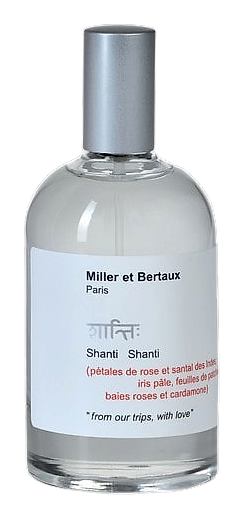
Shanti Shanti arrived in 2008 from Miller et Bertaux, the Parisian design house founded in 1985 by Francis Miller and Patrick Bertaux in the Marais district. The name comes from the Sanskrit word for inner peace, a concept that runs through the brand's wider philosophy of fragrance as style accessory rather than statement. Miller et Bertaux have always treated their perfumes as olfactory postcards, stories you breathe in rather than announce. Shanti Shanti is the house's interpretation of calm itself: not stillness as absence, but stillness as presence. A composition built around the idea that confidence doesn't need to raise its voice.
What makes Shanti Shanti interesting as a composition is the way it refuses the obvious path. Rose fragrances often begin with sweetness and stay there, or bloom into something heavier. Here, Bulgarian rose opens alongside cardamom, a spice that doesn't sweeten the rose so much as sharpen it, give it edges. The effect is a rose that feels awake rather than languorous. Iris enters the middle with its characteristic powdery elegance, but here it reads less like grandmother's violet and more like the mineral dust of a clean studio, warm light, not sweet fog.
The evolution
Cardamom hits first, not the citrusy top note kind, but a warm, almost resinous cardamom that feels like spice without heat. It opens clean, bright, deliberate. Within minutes, Bulgarian rose arrives. Not a wall of petals. A single stem, held loosely. The cardamom doesn't disappear, it stays underneath, keeping the rose honest, stopping it from becoming decorative. Iris takes over around the thirty-minute mark, bringing its powdery, slightly mineral quality. This is the phase where Shanti Shanti shifts from floral to something more abstract, a soft, atmospheric warmth that isn't quite violet, isn't quite skin, isn't quite anything you can name but everything you'd want to keep. Patchouli and sandalwood arrive quietly around hour two. The patchouli isn't the loud, earthy kind, it's dry, restrained, more texture than statement. Sandalwood smooths everything underneath, leaving a warm woody trace that persists on fabric long after the skin phase ends. On skin, expect six to eight hours.
Cultural impact
Shanti Shanti occupies a specific corner of niche fragrance: the warm-spiced rose for people who find most rose fragrances too sweet or too obvious. Miller et Bertaux's 2008 release predates the current wave of powdery, iris-forward compositions but reads as remarkably contemporary in retrospect, the iris heart feels very much of the now. Among its peers in the rose-patchouli-sandalwood space, it stands apart through restraint: less oud, less projection, more intimacy. The wearer who reaches for Shanti Shanti tends to be someone who has tried enough fragrances to know what she likes and has stopped needing the room to agree.