The Story
Why it exists.
The beginning
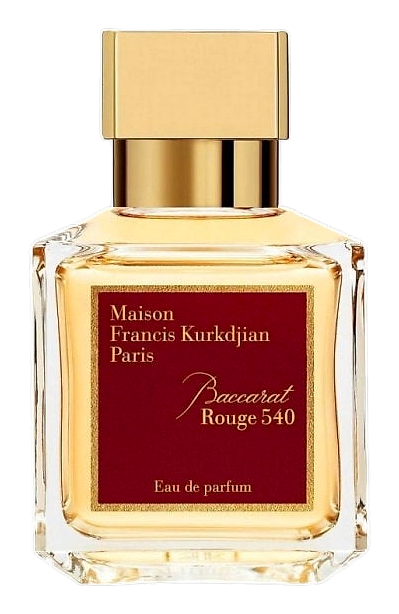
Some fragrances arrive as concepts. This one arrived as a question: what does liquid crystal smell like? Francis Kurkdjian launched Baccarat Rouge 540 in 2016, and the name alone became the conversation. The fragrance that carries it spends every minute of its wear chasing a quality that is less about any single raw material and more about how its components interact with air, heat, and skin. There is a threshold state the composition reaches, something suspended between sensory categories, neither fully sweet nor fully mineral, neither transparent nor dense. It occupies that edge and holds there.
What makes the composition genuinely unusual is its restraint. Alongside Hedione, Ambroxan becomes the architecture. The pairing creates a radiant, almost mineral sweetness, less skin-warmth and more the prismatic glow of light through cut glass. Saffron arrives at the top, adding warmth and depth without ever tipping into the territory of food or spice cabinet. The Virginia cedar in the base anchors the entire structure, dry and clean, the kind of wood impression that feels shaped rather than raw. Nothing about the fragrance announces itself from across a room.
The evolution
The first fifteen minutes belong to saffron, and the experience is immediate. There's no dusty market-stall spice. Instead, a warm, almost metallic red glow, something that reads as heat without weight. It feels closer to the warmth of sun on stone than to anything you'd find in a kitchen. By thirty minutes, the saffron has thinned to a haze, and Ambroxan takes over. This is where the fragrance earns its reputation. The Ambroxan doesn't smell like anything obvious. It smells like warmth held in skin, like a mineral sweetness that hovers in the air around the wearer rather than projecting outward in a defined sillage. Hedione quietly lifts the whole composition, adding an airy, almost crystalline transparency that prevents the sweetness from ever settling into anything thick or syrupy.
Cultural impact
Baccarat Rouge 540 has reached a level of recognition that few contemporary fragrances achieve. Since its 2016 debut, it has become a reference point in conversations about modern amber-woody compositions, referenced regularly in fragrance communities and beyond. The fragrance is often cited as a turning point in how radiant sweetness is constructed, using Ambroxan and Hedione in proportions that produce a distinct, almost mineral glow. Its reach extends across price points, with the Zara and Lattafa interpretations listed as similar fragrances reflecting how widely the profile has been studied and recreated.