The Story
Why it exists.
The beginning
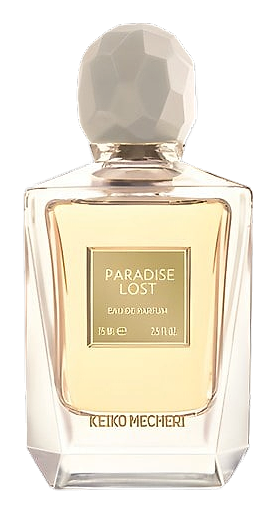
Paradise Lost arrived in 2011, joining a decade of niche experimentation for a Beverly Hills house that had already built a reputation for balancing tradition with something a little more daring. The Keiko Mecheri house was known for compositions that felt personal rather than commercial, Attar de Roses, Loukhoum, Datura Blanche. By 2011, the creative energy pointed toward something with more presence, more volume. Paradise Lost was the answer. The name itself asks a question every wearer has to answer for themselves: what happens when paradise isn't a destination but a departure? The house let the idea guide the materials rather than the other way around, tropical florals and warm woods assembled into something that doesn't wait for permission.
What makes Paradise Lost structurally interesting is the tension between its opening and its base. The citrus top, Indian lime, bergamot, reads clean and bright, almost deceptively simple. Then the heart delivers Indian tuberose and jasmine at full intensity, a white floral richness that can read as overwhelming on paper. The saving grace is what the official description calls "suede", that soft, warm, slightly powdery quality that threads through the coconut and tiaré. Without it, the composition would be all garden. With it, the garden has texture, weight, somewhere to sit down.
The evolution
The opening does exactly what it promises, bergamot and lime together create something sharper than bergamot alone would manage, tart with a green undertone that hints at stems rather than just fruit. Within minutes, the lime softens and the tropical florals announce themselves. Indian tuberose takes the lead, waxy and milky, with an animalic edge that earns the skatole whisper in the accord list. Jasmine joins within the first hour, amplifying the waxy sweetness until it reads almost as headshop, not unpleasant, but definitely not polite. The coconut doesn't stay hidden. It arrives mid-development, smoothing the florals into something creamier and more approachable. By the 2-3 hour mark, sandalwood and Tahitian vanilla establish themselves, pulling the composition toward warmth and soft powder. The musk keeps everything close to the skin, moderate sillage meaning you smell it more than the room does.
Cultural impact
Paradise Lost occupies an interesting position in the niche landscape, not quite the powdery incense signatures that defined the house's earlier work, not quite the urban narratives of later releases. The 2011 launch date places it in a moment when tropical florals were experiencing a renaissance in independent perfumery, particularly tuberose-forward compositions that drew from both the Pacific floral tradition and Western gourmand aesthetics. For the Keiko Mecheri house, this fragrance represented a willingness to be heard rather than merely discovered, a composition that asks for attention rather than earning it quietly.