
The Story
Why it exists.
The beginning
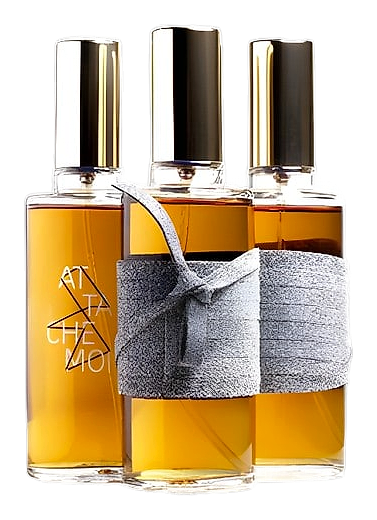
Attache-Moi arrived in 2009 as ICONOFLY's opening statement, a curatorial house staking its claim in the space between art object and fragrance. The name means 'tie me up,' and the brand delivered exactly that: a bracelet-wrapped bottle at Bon Marché Rive Gauche, packaging that physically bound the object to the body it would eventually scent. Christine Nagel and Benoist Lapouza built something that felt like a secret kept in plain sight.
Amber and musk are ancient materials, resins that fossilized before humans had language to name them. Resinous notes don't simply perfume; they trap. The combination here creates something that adheres to skin rather than dissipating into air. This is fragrance as attachment, as binding, as the thing that stays when everything else has cleared the room. Nagel and Lapouza chose materials that resist easy wearability in favor of permanent impression.
The evolution
It opens warm, almost sticky, resinous amber that feels like holding hands in August. The musk arrives within minutes, not animalic in a aggressive sense, but present. Biological. The powder note some reviewers mention doesn't appear immediately; it builds as the woody notes integrate. By hour two, the composition has shifted into something more intimate, more worn. The drydown lasts into evening territory, six to eight hours on most skin types, and what's left isn't a ghost. It's a memory of warmth, amber and musk still entwined, closer than the air around you.
Cultural impact
Attache-Moi found its audience among people who wanted fragrance to mean something beyond trend. The 2009 launch positioned the scent at a moment when niche perfumery was beginning to reshape how collectors thought about scent, not as accessory but as statement. The leather-wrapped bottle, the binding name, the refusal to project loudly: this was fragrance as object with intention.