
The Story
Why it exists.
The beginning
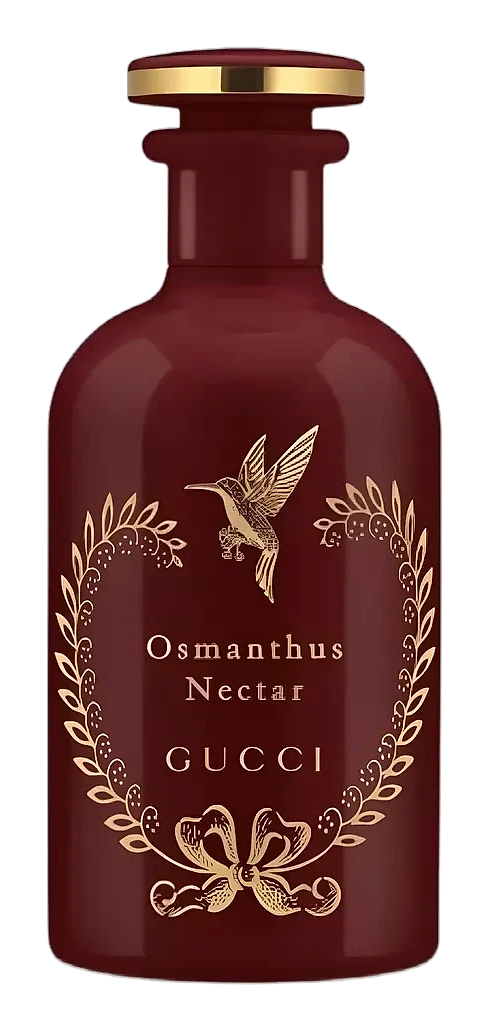
Part of The Alchemist's Garden, Gucci's collection built around the idea that ordinary materials can become something rarer. Osmanthus Nectar was composed in 2025 by Nathalie Lorson, who approached the osmanthus flower's contradictory nature: it smells like apricot, but beneath the fruit it carries a greener, almost indolic depth that most fragrances hide behind sweetness. She chose not to. The result is a floral that speaks in two directions at once.
The osmanthus flower's defining quality is duality. Its apricot facets are unmistakable to anyone who's smelt桂花 gwei fa in autumn, but under the surface it carries a waxy, almost leathery green note that most perfumers either amplify or excise entirely. Nathalie Lorson threaded it between the sweetness and the wood deliberately. Tea was the bridge, it shares osmanthus's slightly bitter, slightly astringent character without competing. Where other houses approach osmanthus as powder and softness, Gucci turned it into something with a pulse.
The evolution
The opening hits bright. Apricot arrives immediately, tangy and golden, underscored by cardamom's dry spice and bergamot's citrus bite. Within the first twenty minutes the citrus pulls back and the osmanthus-tea heart takes over, the green note from the cardamom doesn't disappear. It transforms, softened by the floral nectar into something rounder, almost herbaceous. The drydown is where it earns its eight hours. Amyris and cedarwood introduce warmth without heaviness, and the synthetic musk Z11 keeps everything close to the skin for hours after the florals have settled into the wood. On some people the drydown reads as a quiet skin scent that lingers past a full workday. On others it stays closer, intimate, present only to those standing beside you.
Cultural impact
Osmanthus has been a cornerstone of Chinese perfumery for centuries, but designer houses have rarely placed it at the center of a composition until recently. Gucci's 2025 addition to The Alchemist's Garden collection marks a deliberate pivot toward more nuanced, contemplative fragrances that borrow from niche perfumery's playbook. The inclusion of osmanthus as a lead note in a mainstream designer release signals a shift in what luxury fragrance consumers are seeking: complexity and cultural specificity over blind familiarity. Warm woods and tea-form bridge the gap between Mediterranean brightness and Oriental depth, positioning this as an escapist proposition for the collector who wants something niche-leaning without the niche price tag.