
The Story
Why it exists.
The beginning
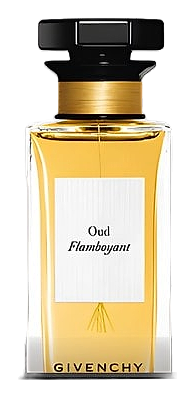
Pierre Negrin composed Oud Flamboyant in 2014 as part of L'Atelier de Givenchy, the house's creative workshop series featuring seven fragrances, each built around exceptional raw materials and conceived as olfactory counterparts to Givenchy's couture. The collection reads like a perfumer's sketchbook: an amber that bites, a leather that whispers, a wood that remembers. Within this framework, Oud Flamboyant explores the intersection of three potent note families, oud, labdanum, and leather, each demanding space in the composition. The brief asked for an interplay between these materials, building a scent that would honor their individual characters while finding a unified expression.
What makes this structure remarkable is what it refuses to do. No top-note citrus to soften the landing. No hedione to modernise the finish. Just oud, labdanum, and leather, a trio that could easily collapse into noise, yet here they reach a kind of quiet authority. The labdanum does the heavy lifting most people don't notice: it bridges the gap between the medicinal sharpness of oud and the smoky warmth of leather, turning three monothematic materials into something that reads as singular. It's an exercise in restraint that only works because none of the three ingredients is holding back.
The evolution
The opening lands with immediate weight. Smoke and resin press close to the skin before you can reach for your wrist. There's no hesitation here, the labdanum and oud arrive simultaneously, the leather following within minutes like a shadow. What surprises is the warmth: this isn't cold, clinical oud. It's the oud of an incense shop next to a leather tannery, the smell of ancient markets translated without apology. The leather gains presence as the first hour unfolds, adding a tactile, almost physical dimension, the suggestion of treated hide warming under fingers rather than sitting distant and abstract. By hour three, the three notes have dissolved into something unified and close. Not linear, but inseparable. The projection shifts as it settles, pulling closer to the skin, becoming intimate rather than announced.
Cultural impact
Oud Flamboyant arrived in 2014 as part of Givenchy's L'Atelier de Givenchy collection, a series that explored raw materials treated as objects rather than notes. Pierre Negrin built the scent around materials chosen for their expressive potential, creating compositions that would evoke fashion creations and the materials associated with them. The seven-fragrance collection presented each raw material as a distinct subject worthy of close attention, with the fragrances conceived as olfactory counterparts to the house's couture.