
The Story
Why it exists.
The beginning
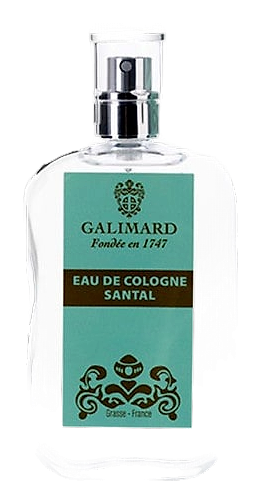
Santal is a Galimard fragrance, and the brief is written into the name: sandalwood, and the mood that builds around it. Galimard is a French perfumer with deep roots in Grasse, the historic center of French perfumery in the south of France, and Santal belongs to that tradition. The official accords list a woody, powdery, warm spicy, balsamic, aromatic profile, which captures the texture of the composition in shorthand. Sandalwood anchors the scent, giving it a creamy, grounded character that carries the rest of the structure. As an Eau de Cologne concentration, Santal occupies the lighter end of the Galimard catalog, a daytime-leaning composition that trades sheer intensity for smoothness and wearability.
What makes Santal worth paying attention to is how lean the composition stays. Sandalwood carries the full weight of the fragrance, and the accords around it tell the story of how it wears. The main accord listing names woody, powdery, warm spicy, balsamic, and aromatic as the dominant descriptors, and each one points to a different facet of the same central material. The powdery quality softens the wood, giving it a diffused, almost chalky edge rather than a raw lumber roughness.
The evolution
Santal is built to evolve slowly on skin, with sandalwood doing the work from first contact to final fade. In the opening minutes, the sandalwood arrives creamy and almost milky, soft rather than dense, with the powdery accord already pulling at the surface and giving the whole thing a hazy, diffused quality. As the first hour settles in, the warm spicy facet begins to register more clearly, threading through the cream with a dry, peppery warmth that keeps the wood from turning flat. The balsamic quality surfaces next, adding a faint sweetness that reads more like resin than sugar, the kind of warm undertone you might associate with amber-toned woods or aged timber. By the midpoint of the wear, the aromatic accord lifts the composition slightly, introducing a clean, almost herbal brightness that prevents the sandalwood from sinking too low.
Cultural impact
Santal occupies a particular place in the broader landscape of sandalwood fragrances, one defined by restraint rather than density. Sandalwood has been a cornerstone material in Western perfumery for generations, valued for its creamy, warm character and its ability to anchor compositions across genders and styles. Where some sandalwood-led fragrances aim for weight, resin, and projection, Santal keeps its proportions lean, working within an Eau de Cologne concentration that lets the wood breathe rather than smother.