The Story
Why it exists.
The beginning
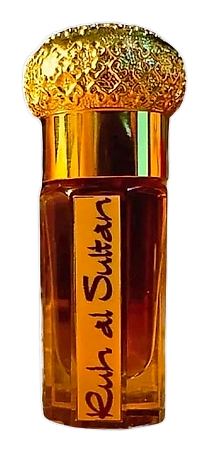
Anas Sabrani conceived Ruh Al Sultan as an architectural exercise in presence rather than progression. The name translates to 'Soul of the Sultan,' and Sabrani wanted to capture the unapologetic confidence of Ottoman courtly authority through fragrance architecture. Rather than designing a traditional pyramid with top, heart, and base notes, he built the perfume as an immediate statement. There are no opening notes, no transition from light to dark. The heart arrives fully formed. This structure mirrors the Sultan's entrance into a throne room, unannounced and commanding from the first step. Each material in the heart serves this intent: Oud and Myrrh establish the resinous depth expected of royal olfactive tradition, while Sandalwood, Frankincense, Jasmine, Rose, Osmanthus, and Vetiver provide complexity within that commanding framework.
Sabrani selected each material in the heart accord intentionally, building around the assumption that a sultan's soul requires no introduction. The Oud and Myrrh provide the deep resinous foundation that defines Middle Eastern perfumery's most revered materials. Sandalwood offers Indian aromatic tradition, while Frankincense carries Arabian incense heritage. Jasmine and Rose represent floral refinement found across both regions. Osmanthus adds a more unusual note, its apricot-like complexity preventing the composition from becoming monolithic. Vetiver grounds the ensemble with its earthy, masculine character. These pairings are not arbitrary.
The evolution
Without a traditional opening or drydown, Ruh Al Sultan evolves not through phase transitions but through the gradual settling of its heart accord upon the skin. From the first application, Oud and Myrrh project assertively, their resinous smoke announcing the fragrance's arrival. Frankincense adds an aromatic counterpoint that weaves between the heavier materials. As the fragrance develops in the first hour, the floral heart notes emerge more prominently. Jasmine and Rose petals interweave dynamically, with Osmanthus introducing its apricot-like sweetness as a counterbalance to the resins. Vetiver remains present throughout, providing earthy grounding that ensures the composition never feels hollow or diffuse. The sillage expands notably around the one-to-three hour mark as the florals and resins achieve equilibrium. Over time, projection moderates slightly as the fragrance integrates with skin chemistry, but the heart persists with remarkable longevity, the Oud and Myrrh maintaining their resinous presence until the final moments.
Cultural impact
Ruh Al Sultan taps into a resurgence of interest in Middle‑Eastern heritage fragrances, echoing the historic use of jasmine and oud in royal courts. Its launch in 2024 sparked conversations on social media about cultural authenticity, with perfumers and historians noting the careful balance of Egyptian jasmine against Laotian oud. The scent has been featured in museum exhibitions exploring scent as cultural memory, reinforcing the idea that fragrance can act as a bridge between past and present. By highlighting traditional ingredients while employing modern extraction methods, the perfume encourages a dialogue about preserving artisanal practices in a global market.