The Story
Why it exists.
The beginning
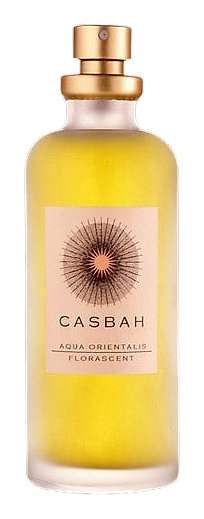
Casbah belongs to Florascent's Aqua Orientalis collection, a sub-line built around the idea that oriental ingredients don't need to be loud to be true. The name refers to the fortified medinas of North Africa, the ancient walled quarters where daily life happens behind gates that keep the city at arm's length. It's a concept about privacy, about things worth preserving inside a space rather than broadcasting to the world. The fragrance translates that into a composition that opens with Moroccan rose and mimosa, two yellow florals that carry sunlight differently, one deep and velvety, one green and powdery, before the spices arrive to complicate the picture. Black tea anchors the heart. The result is a fragrance that smells like a place: enclosed, layered, with warmth that accumulates rather than explodes. The Aqua Orientalis line itself gathers scents named for Moroccan cities and concepts: Ksar, Medina, Tishka, Bahou.
What makes Casbah structurally interesting is the yellow floral axis, mimosa and Moroccan rose together. Yellow florals occupy a specific niche in perfumery: they're warmer than whites (jasmine, tuberose), less sharp than pinks (rose, peony), and carry a particular kind of powdery sweetness that sits between floral and woody in the accord spectrum. In this composition, that axis does double duty: it provides the initial sensory impression (bright, warm, inviting) and sets up the contrast with what follows. The black tea in the heart is the structural hinge. Tea notes in fragrance are difficult, they risk smelling like wet paper if executed poorly, like stale Earl Grey if done carelessly.
The evolution
The opening arrives in stages. First: mimosa, the green one, slightly powdery, like dried flower petals. Then the Moroccan rose steps in and the composition shifts, deeper, rounder, sweeter. For the first twenty minutes, it's primarily floral. Warm and feminine without being juvenile. The tea announces itself quietly, under the florals, beginning to pull the composition toward something earthier. By the thirty-minute mark, the spices arrive, not loudly, not in a way that announces itself as 'spice market,' but as a slow warmth that fills the space the florals are starting to vacate. The transition is graceful. One phase hands off to the next without a hard seam. At hour two, the wood is dominant. Not heavy, not dark, more like the smell of a wooden chest opened in afternoon light. The rose hasn't disappeared; it's receded into the background, present as an undertone rather than a lead. The amber starts to show itself in the base, a resinous warmth that holds everything together.
Cultural impact
Casbah enters a niche perfumery landscape increasingly interested in restraint and cultural specificity. The yellow floral category, once dominated by mainstream florals, has gained legitimacy through houses like Florascent exploring their geographic and botanical roots. Moroccan rose and mimosa represent not just ingredients but a specific aesthetic vocabulary tied to North African perfumery traditions. The use of black tea as a bridging note connects Casbah to the broader tea note renaissance that has swept through niche perfumery over the past decade, where accords like oud-tea and rose-tea have become signatures of modern oriental composition. This fragrance participates in a larger movement toward transparency in ingredient sourcing, with Florascent's field-trip model reflecting a consumer appetite for provenance stories. The Aqua Orientalis collection framework positions Casbah within a curated lineage, suggesting that restraint and cultural authenticity can coexist with oriental warmth.