The Story
Why it exists.
The beginning
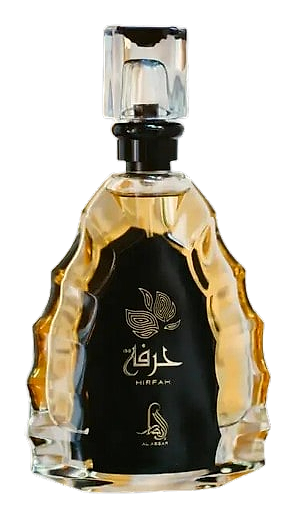
Hirfah opens with a clean, deliberate brightness. Black currant and bergamot arrive together, their tart, fruity energy brightening the top without overwhelming. Pink pepper threads through, adding a clean spice that keeps the citrus from feeling predictable. There's an immediate sense of purpose here, a composition that knows exactly what it's doing and doesn't need to shout about it. The brief, as it were, seems to have been simple in the best way. Start clean. Earn the depth. The heart of Hirfah is where the real work happens. Lavender and jasmine occupy opposite ends of the aromatic spectrum. One is cool, aromatic, almost medicinal. The other is warm, indolic, heavy with floral richness.
What makes Hirfah interesting as a composition is the way it stacks contrasts deliberately. Black currant and bergamot open bright and tart, a sharp energy that announces itself immediately. Pink pepper adds a clean spice that prevents the citrus from being predictable. Then the heart pivots to lavender and jasmine, two notes that don't naturally want to coexist in the same sentence. Lavender is cool, aromatic, almost medicinal. Jasmine is warm, indolic, heavy. Creamy notes are the bridge between them, smoothing the handoff so neither feels out of place.
The evolution
The opening hits like a sharp intake of breath. Mandarin and pink pepper don't ease in, they make a statement. The pear in some sources reads as a softness underneath the citrus, rounding the top notes into something that's tart but not aggressive. You get about thirty minutes of this brightness before the hand-off begins. The heart is where Hirfah reveals its middle name. Jasmine arrives rich and almost waxy, while lavender pulls it in the opposite direction, cool, green, slightly soapy. The creamy notes do their job: they keep the two from fighting. For the next two to three hours, this floral duality plays out close to the skin. It's not loud. It's conversational. The drydown is the real reason people talk about this one. Vanilla and ambergris together create something that reads as powdery-warm with an animalic undertone that stops just short of obvious. The musk anchors everything into a quiet warmth that lingers for hours on most skin types. On fabric, it settles into something almost imperceptible, a smell rather than a statement.
Cultural impact
Hirfah sits in a specific cultural moment, the rise of accessible Middle Eastern niche fragrances in Western markets. Collectors of Arabic perfume, long accustomed to high-concentration oud and amber blends in luxury formats, found in Hirfah a composition that delivered similar warmth and animalic depth at a different price point. The vanilla-lavender-ambergris combination struck a chord with wearers drawn to powdery warmth without theatrical projection. Social media features from fragrance creators have highlighted it as an entry point into the Al Absar catalog, the scent that makes people want to explore the rest.