The Story
Why it exists.
The beginning
Amber Kashmir arrived in 1925, the work of perfumer Ahmed Soliman. The composition draws its character from resin and floral materials long central to perfume traditions across North Africa, the Levant, and South Asia. Warm, sweet, slightly animalic, and unapologetically dense, the juice sits within a heritage of thick, skin-hugging compositions that prioritize depth and longevity over the sparkling projection associated with lighter styles. The amber accord that anchors the fragrance is not a single ingredient but a blended impression, the kind of constructed warmth that perfumers achieve by layering labdanum, benzoin, and balsamic sweetness into a single rounded chord.
What distinguishes Amber Kashmir from many of its contemporaries is the way it presents on skin. The juice has a viscous, almost syrupy weight in the bottle, and that density translates directly into how it behaves once applied. Materials of this type don't vanish quickly. They settle into the warmth of the skin and begin to release in slow waves, so the opening impression is less a burst of scent than a sustained presence. The resins in particular read as foundational, a golden lattice that holds everything else in place, while the sweeter notes orbit around that structure.
The evolution
On skin, Amber Kashmir opens with a thick, almost medicinal warmth, a heat that feels pre-lit, as though the materials have been quietly releasing their character long before the bottle was ever opened. There's no bright citrus to slice through, no aldehyde sparkle to lighten the start. The first twenty minutes are dense and enveloping, with a sweetness layered over a resinous undertone that coats rather than sprays. The heart phase doesn't announce itself through floral transition so much as through intensification. The sweeter elements merge with the resin backbone, and the composition tightens into something that reads less like a perfume and more like an aromatic material pressed into fabric. By the two-hour mark, the sharpest contours have softened, and what's left is a warm, balsamic close hovering close to the skin.
Cultural impact
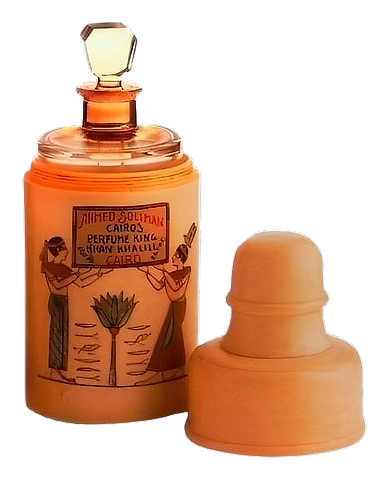
Amber Kashmir holds an unusual position among fragrances of its era, a composition whose particular style of richness never achieved wide commercial distribution outside its region of origin. The original presentation came in a long rectangular red glass bottle, a design choice that gave the juice a distinctive visual identity on the dressing table. Original bottles from the early production run appear occasionally in antique channels, where their age and condition make them desirable to those who collect early perfume history.