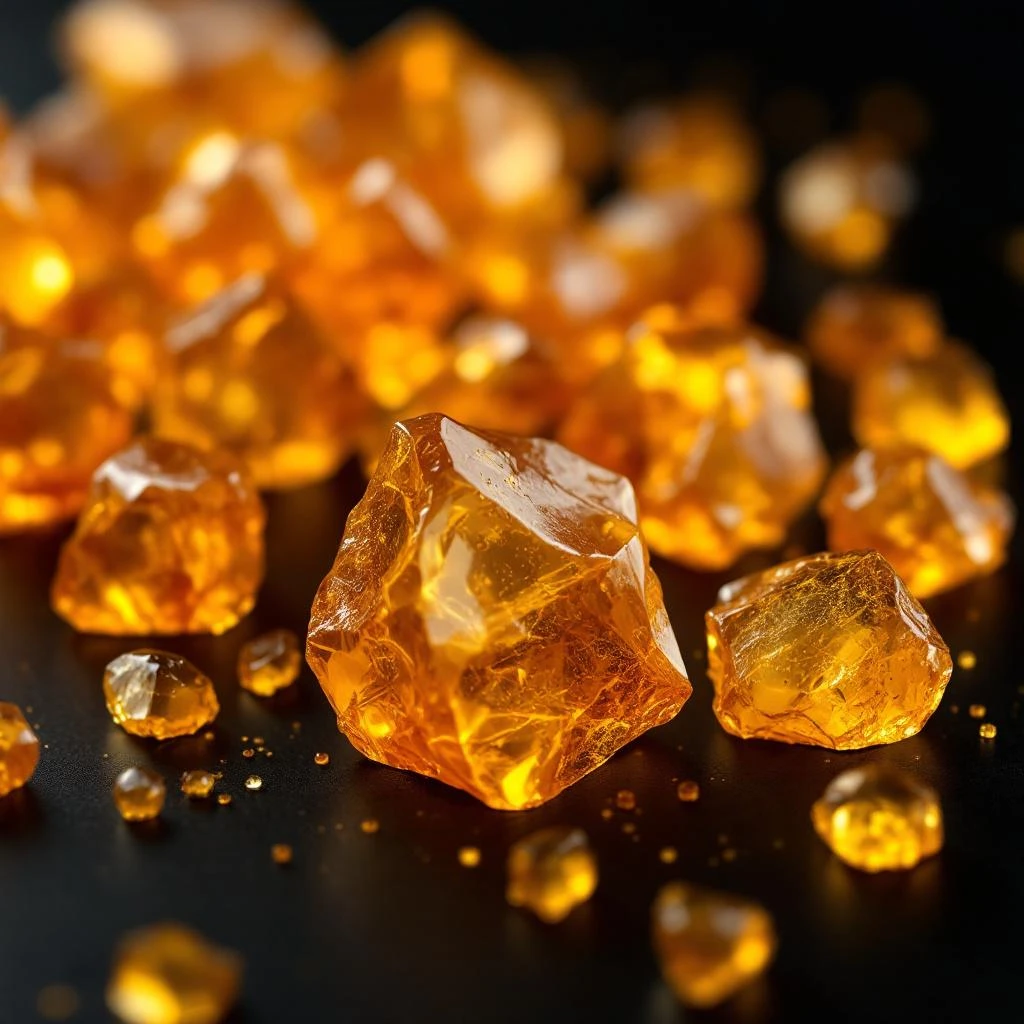
Musky Amber
Musky amber blends warm, animalic depth with golden resinous sweetness. This beloved combination traces thousands of years, evolving from rare natural ingredients to precise modern synthetics. Its story spans continents and centuries.
Character
How it smells
Warmth that wraps. Depth that lingers.
Sumerians used natural musk over 4,000 years ago, centuries before synthetic alternatives existed.


Origin
Germany
Musk appears in some of humanity's earliest records. The Sumerians documented its use in Mesopotamia around 3000 BCE, valuing it for sacred rituals and medicinal applications. Trade routes eventually connected Egypt, Rome, and Greece to Tibet and China, where musk deer populated high Himalayan forests.
Ancient physicians prescribed musk for everything from headaches to melancholy. European royalty prized ambergris during the Renaissance, paying fortunes for floating specimens washed ashore. The 1979 CITES convention finally banned international trade in natural musk deer, concluding centuries of increasingly scarce and cruel harvesting.
This prohibition accelerated development of synthetic alternatives that now dominate perfumery. Meanwhile, ambergris remains legally ambiguous in most jurisdictions, making synthetic musks the practical choice for contemporary creators seeking consistent, ethical raw materials.
Wears it best
Fragrances featuring Musky Amber
Brands
Brands known for Musky Amber
Good to know
Questions, answered
The essentials on Musky Amber in perfumery: how it smells, where it comes from, and how it behaves on skin.
What exactly is musky amber in perfumery?
Musky amber refers to a warm, enveloping fragrance family combining resinous amber notes with soft, skin-like musks. It creates sensations of warmth, comfort, and intimacy. These materials act as fixatives, helping lighter top notes linger longer on skin.
Is the musk in musky amber derived from animals?
No. The 1979 CITES convention banned international trade in natural musk deer, and ethical concerns eliminated most animal-derived musks. Modern musky amber uses synthetic alternatives engineered in laboratories to replicate natural musk's warmth and fixative properties.
When did perfumers first create synthetic musk?
Chemists developed the first artificial musks in 1888 with nitro-musks like musk ketone. The breakthrough came decades before modern fragrance chemistry existed, making musk one of the earliest fragrance ingredients successfully synthesized.
What does musky amber smell like?
Musky amber typically reads as warm, powdery, and slightly sweet with animalic undertones. Think sun-warmed skin, clean laundry dried outdoors, or the soft scent where neck meets collar. Individual variations range from light and ethereal to deep and sensual.
How long have humans used musk in fragrance?
Evidence dates to approximately 3000 BCE in Sumerian Mesopotamia, making musk over 5,000 years old. This predates written language in many cultures and spans virtually all documented human civilizations.
What is ambergris, and is it used in musky amber?
Ambergris is a waxy intestinal secretion from sperm whales, prized for centuries as a fixative. Only about 1% of sperm whales produce it, making natural ambergris extremely rare. Most modern fragrances use synthetic alternatives due to availability and ethical considerations.
How many synthetic musk variants exist today?
Fragrance chemists have developed hundreds of synthetic musk compounds, broadly categorized as nitro-musks, polycyclic musks, and macrocyclic musks. Major fragrance houses continuously research new variants offering improved performance, safety, or unique olfactory profiles.
Does musky amber occur naturally in any plant?
Some plants produce musky-smelling compounds, including ambrette seed and angelica root. However, these natural sources cannot supply commercial perfumery demands. Synthetic production remains the practical source for consistent, sustainable musky amber materials.