Lamprocapnos
Lamprocapnos, known as the bleeding heart flower, lends a whisper-soft green floralcy to rare perfumery compositions. Its delicate, watery sweetness evokes shaded woodland gardens in early spring.
Character
How it smells
A woodland flower's shy, green-floral whisper.
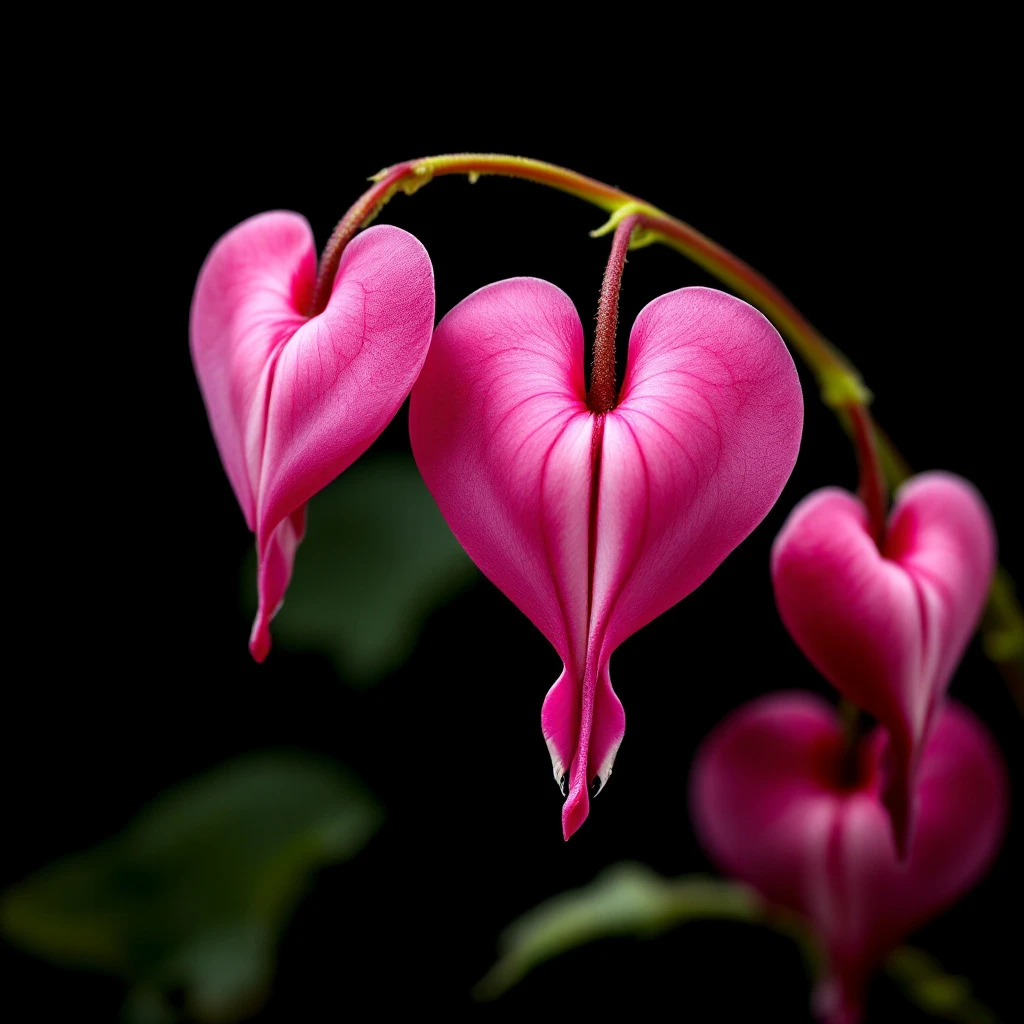
Lamprocapnos is commonly called bleeding heart because each pink blossom is shaped like a droplet split open at the bottom, a form that has captivated botanists since the 1800s.
Pairs beautifully with


Origin
China
Lamprocapnos spectabilis, the Asian bleeding heart, was first described by Western botanists in the early 19th century after plant collectors brought specimens back from Siberia and northern China. The English botanist John Lindley formally classified it in 1847, separating it from the related European genus Corydalis. Its pendant flowers, each resembling a pink heart with a white droplet beneath, earned it a place in Victorian cottage gardens across Europe and North America by the mid-1800s.
Despite its long ornamental history, the plant entered fragrance chemistry relatively late. Traditional perfumers focused on more oil-rich blooms like rose, jasmine, and tuberose, leaving the watery, faintly green scent of bleeding heart largely unexplored. Interest grew during the late 20th century as artisan perfumers began seeking unusual green-floral materials to create naturalistic compositions.
Today, Lamprocapnos remains a niche ingredient, appreciated by independent perfumers in Europe and Japan who value its ability to evoke shaded forest undergrowth and the cool dampness of spring soil in a bottle.
Wears it best
Fragrances featuring Lamprocapnos
Brands
Brands known for Lamprocapnos
Good to know
Questions, answered
The essentials on Lamprocapnos in perfumery: how it smells, where it comes from, and how it behaves on skin.
What does Lamprocapnos smell like in perfumery?
Lamprocapnos absolute offers a soft, green-floral aroma with watery, slightly sweet undertones reminiscent of a shaded spring garden. It reads as airy rather than opulent, lending lift without heaviness to floral compositions.
Why is Lamprocapnos rare in commercial fragrances?
Lamprocapnos yields very little aromatic oil per blossom, making extraction costly and inefficient. Most mainstream houses favor higher-yield florals like rose or jasmine, reserving Lamprocapnos for artisan and niche perfume lines.
Is Lamprocapnos the same as the bleeding heart flower?
Yes. Lamprocapnos spectabilis is the botanical name for the Asian bleeding heart, named by Frederik Liebmann and later reclassified by John Lindley in 1847.
Where does Lamprocapnos originate?
Lamprocapnos spectabilis is native to Siberia, northern China, Korea, and Japan. It was introduced to European horticulture in the 19th century by Scottish botanist Robert Fortune.
How is Lamprocapnos absolute extracted?
Freshly picked Lamprocapnos blossoms are processed through solvent extraction to produce a concrete, which is then washed with ethanol to yield a pale, green-floral absolute. Steam distillation typically damages its delicate volatiles.
Are there safety concerns with Lamprocapnos in perfume?
Lamprocapnos absolute contains isoquinoline alkaloids, including protopine, which can cause skin sensitization in high concentrations. IFRA recommends restricting usage levels in leave-on perfumery formulations.
Can Lamprocapnos be used as a substitute for other florals?
No. Lamprocapnos lacks the depth of rose or the indolic warmth of jasmine. Perfumers use it specifically for its cool, green, watery facets that most other florals cannot replicate.
When was Lamprocapnos first used in perfumery?
Documented perfumery use of Lamprocapnos dates to the late 20th century, when artisan perfumers began experimenting with unconventional green-floral materials. Earlier references appear only in ornamental horticulture literature.





