The Story
Why it exists.
The beginning
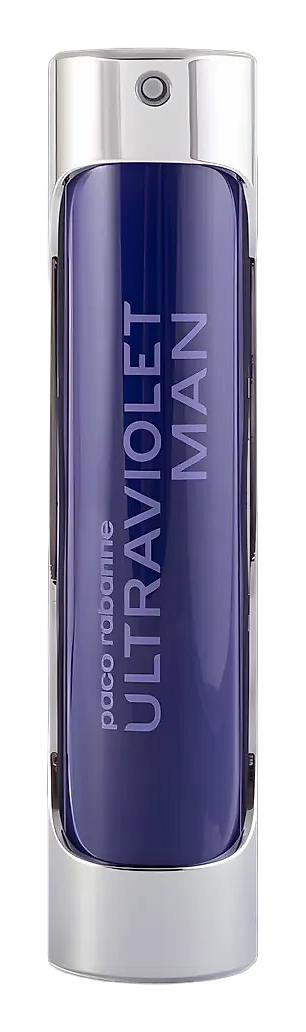
Rabanne arrived in Paris in 1966, founded by Spanish-born Paco Rabanne, and immediately upended expectations by constructing garments from industrial chain mail, plastic, and metal. That confrontational spirit extended into fragrance, beginning with the original Ultraviolet in 1969. Ultraviolet Man arrived in 2001, named for the invisible spectrum just beyond violet, the color Paco Rabanne called the hue of the Age of Aquarius. The brief was clear: masculine, architectural in structure, built to provoke rather than soothe. Jacques Cavallier-Belletrud worked from that provocation, translating Rabanne's industrial aesthetic into olfactory form.
The note selection reflects a deliberate philosophy of contrast. Coriander and Italian mint create an opening that is bright, sharp, and almost clinical, a deliberate rejection of softness. Ambergris and black pepper form a heart that introduces warmth and animalic depth without surrendering the confrontational edge. Patchouli and crystallised moss anchor the drydown with mineral earth, grounding the composition in something quiet and grounded. The result is a fragrance that mirrors the invisible ultraviolet spectrum, present but not immediately visible, provocative but not aggressive, modern in a way that still feels relevant twenty years after its creation.
The evolution
The opening hits immediately with Italian mint and coriander, an electric jolt that feels cool and precise, almost like stepping into a space lit by fluorescent light. The coriander provides a faintly green lift while the mint creates an immediate, biting freshness that does not apologize for itself. Within minutes, ambergris begins to surface through the mint, introducing a salty, mineral warmth that pushes back against the opening coolness. Black pepper follows, lending a dry spice that defines the heart for the next several hours. This is the core of the fragrance, the middle ground where brightness and warmth wage a quiet war. As the black pepper slowly dissipates, crystallised moss emerges, bringing a cool, metallic mineral quality that recalls wet stone. Patchouli grounds the composition, its earthy depth absorbing the earlier brightness and leaving something quieter, more contemplative, in its place.
Cultural impact
Ultraviolet Man carved its territory in the early 2000s masculine market, a period when masculine fragrance was still working through its relationship with aquatics and fresh woody compositions. Its sweet-synthetic character positioned it as something with an edge, a fragrance that didn't wait for permission to be opinionated. The women who wore the feminine version wanted something bolder; the men who reached for this wanted the same. Reviewers consistently note the gray amber as the standout material, amplified by the vetiver and moss, a combination that reads as distinctive even within the broader Rabanne portfolio.